
Nobody in their thirties thinks they need to worry about brain health. That’s a concern for later, for the decades when words start coming more slowly and names begin to slip. Right now there are careers to build, relationships to manage, children to raise, and approximately four hundred other things competing for attention. The brain is just there, doing its job, taken almost entirely for granted.
Here’s the quiet irony in that assumption: your thirties are precisely when brain health decisions matter most. Not because decline is imminent, but because the habits, inputs, and investments you make now determine the cognitive baseline from which you’ll be working for the next four or five decades. The brain you have at seventy is largely being shaped by what you’re doing, or not doing, right now. And that’s either a sobering thought or an empowering one, depending on how you choose to hold it.
What’s Actually Happening in the Brain During Your 30s
The popular narrative positions cognitive decline as something that begins at sixty or perhaps fifty. The research tells a more nuanced story. Some aspects of cognitive processing begin their gradual shift as early as the late twenties and early thirties. Processing speed, the rate at which the brain handles new information, peaks in the mid-twenties. Working memory capacity begins its slow arc of change around the same time. These are subtle changes and in a healthy brain they’re more than compensated for by the concurrent growth in crystallized intelligence, accumulated knowledge, pattern recognition, and the kind of judgment that only comes from genuine experience.
But the broader point stands: the brain in the thirties is not static. It’s in a period of ongoing change, and the conditions surrounding it during that period have meaningful consequences for what comes later.
The Concept of Cognitive Reserve
Neuroscientists use the term cognitive reserve to describe the brain’s resilience against age-related change and neurological insult. A brain with high cognitive reserve can sustain more damage or more change before that change becomes functionally apparent. Think of it as the difference between two buildings of identical age where one was constructed with higher-quality materials and better maintained throughout its life. When the same storm hits, they don’t respond equally.
Cognitive reserve is built through education, intellectual challenge, physical activity, social engagement, and nutritional support, and it is built most efficiently when the brain is still in its peak adaptive phase. Your thirties sit squarely in that window. The investments made now contribute to a reserve that will pay returns silently and steadily for decades, most visibly when the people who didn’t make those investments begin to show decline that you simply don’t.
The Lifestyle Pillars Worth Taking Seriously Now
The evidence on what builds and maintains cognitive health over a lifetime is remarkably consistent. The variables that appear repeatedly across longitudinal studies, twin studies, and intervention trials are not surprising, but their long-term magnitude often is.
Exercise as a Long-Term Brain Investment
Aerobic exercise is the most robustly supported cognitive health intervention in the scientific literature, with effects that extend well beyond what most people appreciate. Regular aerobic activity stimulates the production of Brain-Derived Neurotrophic Factor, which promotes neuronal growth, maintenance, and the formation of new synaptic connections. It supports hippocampal neurogenesis, the growth of new neurons in the brain’s primary memory region. It improves cerebral blood flow, reduces neuroinflammation, and has been shown in long-term studies to significantly reduce the risk of dementia several decades later.
In your thirties, the practical goal isn’t to achieve an elite fitness level. It’s to establish a consistent pattern, three to five sessions per week of moderately intense aerobic activity, that becomes as unremarkable a part of life as brushing your teeth. Consistency over decades is the variable that matters most. The person who walks briskly for thirty minutes five days a week from age thirty-five to sixty-five has built something considerably more valuable than the person who cycles intensely for six months every few years.
Sleep: The Investment Most Thirty-Somethings Are Not Making
The thirties are frequently when sleep begins to be treated as a negotiable resource. Career pressure, young children, social obligations, and the creeping belief that productivity requires sacrifice all conspire against the seven to nine hours that brain health actually requires. This is the period when the sleep debt many people carry begins to compound in ways that don’t fully reveal themselves until much later.
The glymphatic system, the brain’s waste-clearance mechanism, operates primarily during deep sleep. It removes metabolic byproducts from brain tissue, including beta-amyloid and tau proteins whose accumulation is central to Alzheimer’s pathology. Chronically short or poor-quality sleep in midlife has been directly associated in longitudinal research with increased risk of cognitive decline and dementia decades later. The relationship isn’t casual or correlational in a hand-wavy sense. The mechanisms are increasingly well understood. Sleep is when the brain cleans house, and skipping it has consequences that accrue quietly over years.
Diet and the Thirty-Year Payoff
Dietary patterns in midlife have demonstrable effects on brain health in later life. The Mediterranean diet, and its cognitive-health-specific variant the MIND diet, consistently appear in the research as associated with slower cognitive aging, better memory performance in later decades, and reduced risk of neurodegenerative disease. The active components appear to include omega-3 fatty acids from algae, oily fish, polyphenols from berries and olive oil, B vitamins from leafy greens and legumes, and the general anti-inflammatory and antioxidant profile of a diet built around whole foods rather than processed ones.
The relevance for your thirties is not that you need to eat perfectly. It’s that dietary patterns established in midlife tend to persist, and their neurological consequences, positive or negative, accumulate over time in ways that a course correction at sixty can only partially address.
Where Supplementation Fits into the Thirty-Something Picture
Brain supplementation in your thirties operates from a different premise than it does at fifty or sixty. At fifty, supplementation is partly remedial, helping to compensate for declining neurotransmitter efficiency, reduced nutrient absorption, and the accumulated effects of decades of variable lifestyle choices. At thirty, it’s something more interesting: genuinely preventive and performance-oriented, supporting a brain that’s still highly adaptive and responsive to the inputs it receives.
This distinction matters because it changes what you’re looking for from a supplement. The priority at thirty isn’t compensating for decline. It’s providing the brain with specific compounds that support its current performance while building the conditions for long-term resilience. That means ingredients that support neuroplasticity, protect against oxidative stress, maintain the neurotransmitter systems under heavy cognitive load, and support the cerebrovascular health that will matter more and more as the decades progress.
The Ingredients Worth Prioritizing in Your 30s
Lion’s Mane Mushroom is arguably the most compelling ingredient for the thirty-something brain precisely because its mechanism, stimulating Nerve Growth Factor production and supporting neuroplasticity, is most potent in a brain that retains high adaptive capacity. Citicoline supports brain cell membrane health and mental energy, both relevant to someone running hard professionally and cognitively every day. Bacopa Monnieri’s antioxidant activity in hippocampal tissue has a protective dimension that’s easy to overlook when memory feels fine, but becomes significant when you consider what you’re protecting against over a thirty-year horizon. Rhodiola Rosea addresses the stress-resilience dimension that is almost universally relevant to adults in their thirties, supporting performance under cognitive load and reducing the neurological costs of chronic stress.
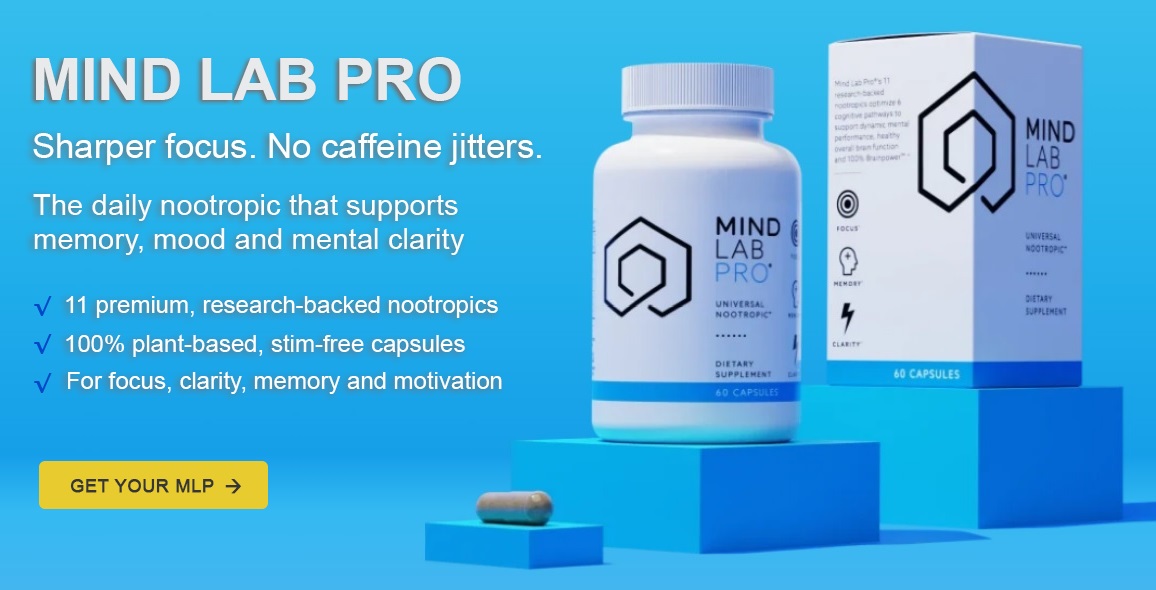
These four ingredients, along with seven complementary compounds targeting focus, mental energy, and neuroprotection, form the core of Mind Lab Pro. Its appeal for the thirty-something audience is somewhat different from its appeal for someone older. The conversation isn’t about recovering lost ground. It’s about building on existing strength, supporting daily cognitive performance while making deposits into the long-term reserve that will determine how this decade’s choices show up twenty or thirty years from now. That’s a frame that resonates differently once you understand what cognitive reserve actually means and how it’s built.
The Compounding Logic of Early Investment
The financial analogy that most people find intuitive is compound interest. A modest investment made at thirty grows into something substantially larger by sixty, not because of any single dramatic event but because of the patient accumulation of consistent returns over time. Brain health works on a similar principle, with one important difference: unlike financial investments, the cognitive reserve you build in your thirties can’t be easily transferred, liquidated, or replicated later. It’s built in the window when the brain is most receptive to it, or it’s not built at all.
That’s not a reason for anxiety. It’s a reason for clarity about what’s worth prioritizing now, while the window is wide open and the returns on investment are at their most generous. The habits that feel optional at thirty, the consistent exercise, the protected sleep, the dietary quality, the deliberate cognitive engagement, become the infrastructure on which everything else depends.
Starting in your thirties doesn’t mean you’re worried about your brain. It means you understand something that most people figure out about a decade too late: that the best time to invest in cognitive health is before you feel you need to. Your future self, sharp and engaged and grateful, will have the context to appreciate that insight in ways your current self can only imagine.