

Most of us have stood in front of a Snellen chart at some point, the one with the big E at the top and progressively smaller rows of letters descending toward the bottom. You’ve read out the smallest line you could manage, and an optometrist has translated that performance into a ratio like 20/20 or 20/40. That ratio is a measure of visual acuity, and it’s the metric most people use to summarize how well they see. But it’s also a number that’s frequently misunderstood, oversimplified, and, frankly, not the whole picture when it comes to visual health and performance.
So what exactly is visual acuity? Can it be improved? And what does the research say about the factors that influence it? These are questions worth taking seriously, because vision is not simply a binary of “good” or “bad,” and understanding the nuances makes it much easier to take meaningful action.
Contents
What Visual Acuity Actually Measures
Visual acuity is a specific measure of the eye’s ability to resolve spatial detail, to distinguish two separate points as distinct rather than merged into one. The Snellen fraction, that 20/20 ratio, indicates that you can read at 20 feet what a person with normal vision can read at 20 feet. A score of 20/40 means you need to be at 20 feet to see what a typical eye can see at 40 feet. 20/10 vision, which some people have, means you can read at 20 feet what most people have to be 10 feet away to see clearly.
The primary determinant of visual acuity under good lighting is the density and quality of cone photoreceptors in the fovea, the tiny central pit at the heart of the macula. The fovea is where your visual system achieves its highest resolution. When light hits the fovea cleanly and the cones are functioning well, acuity is good. When anything disrupts that process, whether optical factors like refractive error, or biological factors like macular damage, acuity declines.
The Role of the Macular Pigment
Between the lens and the photoreceptors sits the macular pigment, a yellow-orange filter formed by the carotenoids lutein and zeaxanthin. This pigment doesn’t just protect the photoreceptors from blue light; it also reduces chromatic aberration, the tendency of different wavelengths of light to focus at slightly different points, which creates a small but real blurring effect. By filtering out the shortest, most aberration-prone wavelengths before they reach the photoreceptors, the macular pigment contributes to the optical clarity of the retinal image.
This means that macular pigment density, measured as Macular Pigment Ocular Density (MPOD), has a direct relationship with visual acuity. Multiple studies have confirmed that individuals with higher MPOD tend to score better on visual acuity tests, and that nutritional interventions increasing MPOD, particularly with lutein and zeaxanthin, can produce measurable improvements in tested acuity.
What Can and Cannot Be Improved
This is where it’s important to be clear and honest. Visual acuity is influenced by several different factors, and which ones are amenable to change depends on the cause.
Refractive Error: Correctable, Not Improvable Through Nutrition
The most common reason for reduced visual acuity is refractive error: myopia (nearsightedness), hyperopia (farsightedness), and astigmatism. These are structural issues with the eye’s focusing system, caused by the shape of the cornea or lens, and they are corrected with glasses, contact lenses, or refractive surgery. No nutrient, exercise, or supplement will correct refractive error, and any claim otherwise should be viewed with serious skepticism.
Macular Health: Genuinely Improvable Through Nutrition
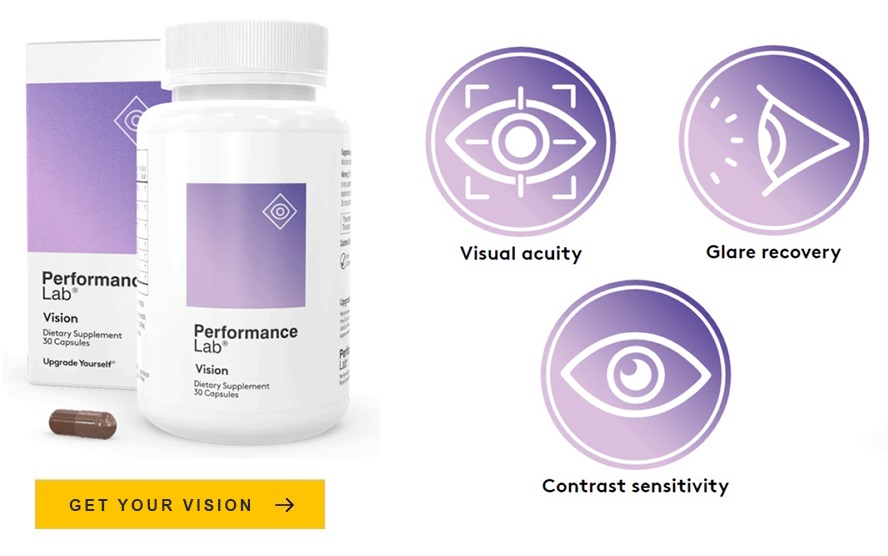
Where nutrition can make a real difference is in the health of the macula and the density of the macular pigment. When visual acuity is limited not by refractive error but by suboptimal macular function, which is common as people age and as macular pigment density declines, nutritional support for the macula can produce measurable improvements.
The evidence here is substantial. Studies supplementing participants with lutein and zeaxanthin have documented improvements in MPOD, and subsequent improvements in visual acuity and contrast sensitivity. The effect is most pronounced in people who start with lower MPOD, but improvements have been observed even in healthy adults with normal starting levels.
Saffron has also shown acuity improvements in clinical trials, particularly in individuals with early macular changes. And astaxanthin, by supporting retinal blood flow and reducing the accommodative fatigue that blurs near vision after prolonged screen use, contributes to functional acuity in everyday situations.
Vision Training: Real But Limited
Another category of acuity improvement deserves mention: visual training. There is legitimate evidence, mostly from sports science, that certain types of perceptual training can improve the brain’s ability to interpret visual information, essentially teaching the visual cortex to extract more detail from the signals the eye provides. This is different from improving the optical quality of vision itself; it’s more like optimizing the software rather than upgrading the hardware.
The improvements from vision training tend to be task-specific and require consistent practice to maintain. They’re real, but they don’t replace the fundamental optical and biological quality of the retinal image that the eye delivers to the brain in the first place.
Lifestyle Factors That Affect Visual Acuity
Several modifiable lifestyle factors influence visual acuity beyond nutrition and training.
Sleep and Hydration
Chronic sleep deprivation and dehydration both impair visual performance, including acuity. The eye’s ability to focus clearly requires adequate tear film stability (affected by dehydration), and the visual cortex’s ability to process detail requires adequate rest. These are not minor variables. Even mild sleep restriction measurably degrades visual processing speed and detail discrimination.
Screen Time and Accommodation
Prolonged near work, especially on digital screens, causes the ciliary muscles that control the lens to fatigue, producing a temporary decline in the sharpness of both near and distance vision. Taking regular breaks using the 20-20-20 rule (every 20 minutes, look at something 20 feet away for 20 seconds) helps manage this, as does nutritional support for accommodative function.
UV and Blue Light Exposure
Chronic exposure to UV light without protection accelerates lens changes that can reduce acuity over time. Blue light from screens contributes to retinal oxidative stress. Protective measures, including sunglasses with full UV protection and nutritional antioxidant support for the retina, help preserve the biological foundations of good acuity over the long term.
A More Complete View of “Seeing Well”
Visual acuity is a useful and important measure, but it’s only one dimension of how well you see. Contrast sensitivity, glare recovery, color discrimination, and depth perception are all components of visual performance that the Snellen chart doesn’t capture. A person with 20/20 acuity on a chart might struggle in low light, fog, or glare because their contrast sensitivity or macular pigment density is suboptimal.
The honest answer to whether visual acuity can be improved is: it depends on what’s limiting it. For refractive error, correction is the answer. For macular health, nutrition is a genuine and well-supported lever. For functional performance, a combination of nutritional support, adequate sleep, and smart habits around screen use goes a long way. The eye deserves more than a single-number verdict, and so does your approach to caring for it.