Nootropic Forms & Bioavailability Compared
The form of a nutrient determines how much reaches your brain. Compare standard, enhanced, and premium forms across 9 nutrient families – and see which versions are backed by the strongest absorption data.
| Form | Nutrient Family | Bioavailability | Brain Penetration | Cost Tier | In MLP? | Key Advantage / Limitation |
|---|
High
Good
Moderate
Low
Cost:
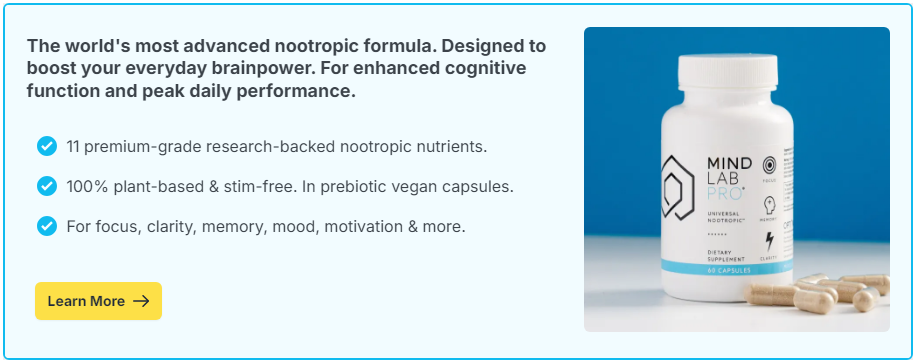
Mind Lab Pro uses premium, high-bioavailability forms throughout its formula – Cognizin® Citicoline, Sharp-PS® Green Phosphatidylserine, Quatrefolic® Folate, Suntheanine® L-Theanine, and more – alongside 7 other research-backed brain nutrients, each chosen to complement and amplify the others in a single daily formula.
Nootropic Forms & Bioavailability Comparison: Why the Form of a Supplement Changes Everything
Two supplements can list the same ingredient on the label and deliver completely different results. The reason is rarely the dose – it is almost always the form. Bioavailability, the proportion of a nutrient that actually enters circulation and reaches brain tissue, varies enormously depending on which chemical form of an ingredient is used. For nootropics in particular, where the target organ is the brain and the blood-brain barrier adds a second layer of filtering, form selection is one of the most consequential decisions a supplement manufacturer makes.
This interactive comparison table covers 21 forms across 9 nootropic nutrient families, rated on bioavailability, brain penetration, and cost tier. The goal is to make an often-opaque subject readable at a glance – so you can evaluate what you are actually buying, not just what the front of the label claims.
What Bioavailability Means for Brain Supplements
Bioavailability measures how much of an ingested nutrient reaches systemic circulation in an active, usable form. For brain-targeted nutrients, there is a second threshold: blood-brain barrier penetration. A compound can be highly bioavailable in the bloodstream yet still fail to cross into brain tissue in meaningful concentrations. This is why the table separates the two ratings. Choline bitartrate, for example, is absorbed reasonably well from the gut – but transfers poorly across the blood-brain barrier, which is precisely why more expensive forms like Cognizin® Citicoline were developed and clinically tested.
A third variable compounds the challenge: conversion efficiency. Several common supplement forms are inactive precursors that must be converted by the body before use. Cyanocobalamin must be converted to methylcobalamin. Folic acid must pass through multiple enzymatic steps to become the active methylfolate the brain uses. Standard pyridoxine must be phosphorylated to P-5-P. Each conversion step introduces a potential bottleneck – and for roughly 40% of adults carrying MTHFR gene variants, the folate conversion pathway is significantly impaired regardless of dose.
Branded Forms vs. Generic Ingredients
Several rows in this table carry a branded form designation – Cognizin®, Sharp-PS® Green, Quatrefolic®, Suntheanine®, Magtein®, KSM-66®. These are not marketing names applied to standard ingredients. They represent patented manufacturing processes, defined extraction or synthesis methods, and in most cases, the specific forms used in published human clinical trials. When a study on L-theanine and attention was conducted using Suntheanine®, replicating that result requires using Suntheanine® – not an unspecified tea extract at a similar dose.
The cost tier column reflects this directly. Premium branded forms carry higher raw material costs, which is why they appear more often in higher-priced finished products. The question worth asking is whether a supplement’s price reflects that ingredient investment or simply a larger marketing budget.
How to Use This Table
Filter by nutrient family if you are evaluating a specific ingredient category – for instance, comparing choline sources or B vitamin forms before purchasing. Use the bioavailability filter to surface only the highest-absorption options across all families. The brain penetration filter is particularly useful for anyone focused on cognitive outcomes specifically, rather than general health. Toggle the In MLP filter to see which forms Mind Lab Pro selects and cross-reference that against the cheaper alternatives in the same family.
Form quality is one of the clearest signals of a supplement manufacturer’s priorities. It is not visible on front-of-label marketing, it does not photograph well, and it adds cost with no immediate consumer-facing benefit – which is exactly why it tends to distinguish serious formulas from commodity ones. Mind Lab Pro includes premium bioavailable forms of all its key ingredients alongside 10 other research-backed brain nutrients, each chosen to complement and amplify the others in a single daily formula.