Nootropic Timing & Stacking Guide
When you take a nootropic matters as much as which one you take. Filter by timing, onset type, caffeine compatibility, and cycling needs — then explore six ready-to-use stacks below.
| Ingredient | When to Take | Onset Type | With Caffeine | Cycling | In MLP? | Timing Notes |
|---|
Part 2 — Scenario Stacks
Six Stacks for Six Situations
Curated ingredient combinations for common cognitive demands. Amber tags = in Mind Lab Pro.
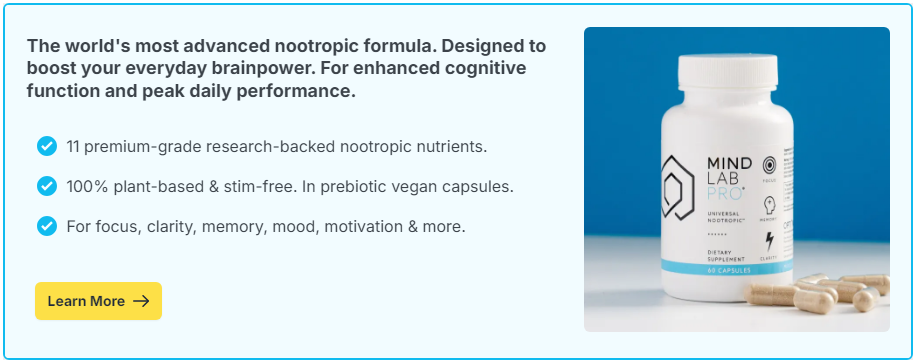
Mind Lab Pro includes 11 of the ingredients in this guide alongside other research-backed brain nutrients — pre-timed in a single morning formula designed for daily use without cycling. Each ingredient complements and amplifies the others so you get the full stack benefit without managing multiple products.
Nootropic Timing & Stacking Guide: When to Take Each Ingredient and How to Combine Them
Choosing the right nootropic ingredient is only half the equation. When you take it – and what you take it alongside – determines how much of that ingredient’s potential you actually access. Timing affects absorption, receptor sensitivity, competition between nutrients for the same transport pathways, and whether an ingredient’s peak effect window aligns with the cognitive demand you are preparing for. This guide covers both dimensions: a filterable reference table for 16 individual ingredients, followed by six curated stacks for specific real-world situations.
Why Timing Matters for Nootropics
Nootropic ingredients divide into two broad onset categories, and understanding the distinction changes how you approach supplementation entirely. Acute-onset ingredients produce measurable effects within the same session – L-Theanine’s alpha-wave promotion becomes noticeable within 30 to 45 minutes, N-Acetyl L-Tyrosine begins supporting dopamine synthesis within an hour, and Alpha-GPC delivers a fast cholinergic boost well-suited to pre-study dosing. These are the ingredients where timing relative to your cognitive task genuinely matters.
Cumulative-onset ingredients operate on an entirely different timescale. Bacopa Monnieri requires 8 to 12 weeks of consistent daily use before its memory consolidation benefits reach clinical significance in human trials. Lion’s Mane Mushroom’s nerve growth factor stimulation builds over 4 to 8 weeks. Magnesium L-Threonate needs 4 to 6 weeks to meaningfully raise brain magnesium levels. For these ingredients, the question is not when to take them today – it is whether you have been taking them consistently enough for today’s dose to matter at all.
Several ingredients straddle both categories, providing acute effects alongside cumulative ones. Citicoline produces measurable brain energy and attention effects within hours of a single dose while also building long-term memory and mitochondrial benefits over weeks. Phosphatidylserine offers acute cortisol buffering on high-demand days while its cell membrane benefits compound over months. Rhodiola Rosea provides same-session stress resilience while its adaptogenic calibration deepens with regular use.
Caffeine Stacking: What Works and What to Watch
Caffeine is the world’s most widely used cognitive enhancer, and most nootropic users consume it daily. The most well-researched nootropic pairing in the literature is L-Theanine with caffeine – typically at a 2:1 theanine-to-caffeine ratio – which reliably smooths caffeine’s stimulant edge while preserving and often enhancing its attention benefits. Most ingredients in this guide pair neutrally or positively with caffeine.
Two ingredients warrant caution in combination. Rhodiola Rosea has stimulant-adjacent properties of its own through dopamine and norepinephrine modulation; stacking it with caffeine on an already high-stress day can push arousal past the optimal range for focused work. Huperzine A, which inhibits acetylcholinesterase to preserve acetylcholine, can interact unpredictably with stimulants and should generally be separated from heavy caffeine use. Ashwagandha’s cortisol-lowering effects also work against caffeine’s alerting mechanism, which is why evening dosing is recommended – not because it is unsafe with caffeine, but because it performs better without competing against it.
How to Use the Scenario Stacks
The six scenario cards below the ingredient table represent common cognitive situations rather than rigid protocols. Each card lists which ingredients address that situation most directly, marks which are inside Mind Lab Pro’s formula, and includes an honest timing note – including dependencies on prior cumulative use that single-session stacking cannot replicate. The Stimulant-Free stack is worth particular attention for readers who avoid caffeine: it demonstrates that clean, sustained cognitive support is achievable through mitochondrial energy, dopamine precursors, and stress-axis modulation without any stimulant involvement whatsoever.
Mind Lab Pro includes 11 of the ingredients in this guide alongside other research-backed brain nutrients – pre-combined in a single morning formula designed for daily use without cycling, so the cumulative-onset ingredients are always active when the acute ones are needed most.