
Alpha Brain is probably the most famous nootropic supplement in the world. It has been sold since 2011, and its association with Joe Rogan – who has discussed it extensively on his podcast and owns equity in Onnit, the company behind it – has given it a level of mainstream name recognition that most supplements never achieve. Mind Lab Pro, by comparison, is less celebrity-driven but has built a devoted following among people who dig into the research behind what they’re taking.
These two products share some surface-level similarities: both are caffeine-free, both target focus, memory, and mental clarity, and both have been on the market long enough to have real-world track records. But there are meaningful differences in how they’re formulated, how transparent each company is about what’s actually in the bottle, and how compelling the evidence is that either product works. This comparison looks at all of it.
Contents
The Philosophy Behind Each Formula
Mind Lab Pro is built on a foundation of ingredient transparency and clinical precision. Every compound in its 11-ingredient formula is listed with its exact dose on the label, and those doses are chosen to align with what published research considers effective. The product has been tested in multiple independent, double-blind, placebo-controlled human trials – a genuinely rare distinction in the supplement industry – and is designed for uncomplicated daily use with no cycling required.
Alpha Brain takes a different approach. Its formula groups ingredients into three proprietary blends – the Onnit Flow Blend, the Onnit Focus Blend, and the Onnit Fuel Blend – which means the total weight of each blend is disclosed on the label, but the individual doses of each ingredient within a blend are not. This is a common industry practice, and Onnit argues it protects its formulation from being copied. Critics, including independent reviewers and at least one 2024 consumer lawsuit, argue that it also makes it impossible for buyers to verify whether any given ingredient is present in a dose that actually does anything. That tension is central to understanding Alpha Brain’s position in this market.
Ingredient Comparison
Both products share a handful of key nootropic ingredients, but with an important caveat: where Mind Lab Pro lists exact doses for every compound, Alpha Brain’s blend structure means the doses for most shared ingredients are unknown to the buyer.
| Ingredient | Mind Lab Pro | Alpha Brain | What It Does |
|---|---|---|---|
| Bacopa Monnieri | 150 mg (45% bacosides) | Yes (dose hidden in blend) | Memory consolidation, learning, stress reduction |
| L-Theanine | 100 mg (Suntheanine®) | Yes (dose hidden in blend) | Alpha brainwave promotion; calm, focused state |
| Phosphatidylserine (PS) | 100 mg (Sharp-PS® Green) | Yes (dose hidden in blend) | Cell membrane integrity; long-term memory |
| L-Tyrosine | 175 mg (N-Acetyl-L-Tyrosine) | Yes (dose hidden in blend) | Neurotransmitter support; focus under stress |
| Alpha-GPC | No | Yes (dose hidden in blend) | Choline precursor; memory and learning |
| Huperzine A (Huperzia serrata) | No | Yes (dose hidden in blend) | Acetylcholinesterase inhibitor; memory (requires cycling) |
| Lion’s Mane Mushroom | 500 mg (Organic, full spectrum) | No (present in Black Label version only) | NGF stimulation; neuroplasticity and brain health |
| Citicoline | 250 mg (Cognizin®) | No (present in Black Label version only) | Brain cell energy, attention, and memory |
| Rhodiola Rosea | 50 mg (3% rosavins) | No | Adaptogen; mental performance under stress |
| Maritime Pine Bark Extract | 75 mg (95% proanthocyanidins) | No | Antioxidant; cerebral blood flow and oxygen delivery |
| Cat’s Claw Extract | No | Yes (240 mg – fully disclosed) | Antioxidant and anti-inflammatory; neuroprotection |
| Oat Straw Extract | No | Yes (dose hidden in blend) | May support alpha brainwave activity and focus |
| Vitamins B6, B9, B12 | Yes (NutriGenesis® forms, fully dosed) | Vitamin B6 only (10 mg, fully disclosed) | Homocysteine control; mood and cognitive function |
The ingredient overlap is real – both products are trying to do roughly similar things, emphasizing acetylcholine support and alpha brainwave activity. But the transparency gap is significant. For the shared ingredients where research gives us target doses – Bacopa Monnieri typically requires around 300 mg standardized to bacosides, for example, and L-Theanine is studied at 100–200 mg – there’s no way for an Alpha Brain buyer to know whether those thresholds are met. Mind Lab Pro’s label answers that question directly.
It’s also worth noting that two of Mind Lab Pro’s most evidence-backed ingredients – Lion’s Mane Mushroom and Citicoline – don’t appear in the standard Alpha Brain formula at all. They were added to Alpha Brain’s premium Black Label upgrade, which carries a higher price and a different formulation. The base Alpha Brain formula instead leans on Huperzine A and Alpha-GPC as its primary acetylcholine stack, both of which are solid ingredients but again present at undisclosed doses.
The Proprietary Blend Problem
This deserves its own discussion because it’s Alpha Brain’s most substantive weakness. Proprietary blends are legal, common, and not inherently fraudulent – but they do shift the burden of trust entirely onto the company. Buyers are asked to believe that the doses are effective without being able to verify it. For a product as expensive and as aggressively marketed as Alpha Brain, that’s a meaningful ask.
A 2024 lawsuit filed against Onnit alleged that Alpha Brain’s advertising overstated its cognitive benefits without sufficient scientific backing. The case predated Unilever’s acquisition of Onnit later that year, but the underlying concern – whether the formula delivers what the marketing promises – remains an open question for independent reviewers. Several have concluded that while Alpha Brain’s ingredient list is credible on its face, the likely doses of most of those ingredients fall short of what clinical studies require to produce measurable effects.
Clinical Evidence
Alpha Brain does have two clinical studies – a genuine differentiator from most nootropics, which have none. One of those studies, published in a peer-reviewed journal, showed improvement in verbal memory and executive function compared to placebo. That’s a meaningful result. The caveat is that both studies were at least partially funded by Onnit, which introduces the possibility of bias, and neither has been independently replicated.
Mind Lab Pro’s clinical record is stronger on this specific dimension. Its formula has been tested in multiple double-blind, placebo-controlled human trials funded independently and published in peer-reviewed academic journals, with statistically significant results in information processing speed, immediate recall, and delayed recall. The fact that the testing covers the complete formula – not just individual ingredients – is the key distinction. Knowing that Bacopa Monnieri improves memory in isolation is useful, but knowing that the specific product you’re buying improves memory at its specific doses is more directly meaningful.
Dosage and Convenience
| Mind Lab Pro | Alpha Brain | |
|---|---|---|
| Capsules per serving | 2 capsules | 2 capsules |
| Recommended schedule | Daily | Daily (though Huperzine A accumulates – cycling advisable) |
| Contains caffeine | No | No |
| Full ingredient transparency | Yes – all doses disclosed | Partial – blends conceal most individual doses |
| Vegan / plant-based capsule | Yes (NutriCaps®) | Yes (cellulose) |
| GMO-free | Yes | Yes (IGEN Non-GMO tested) |
| Gluten-free | Yes | Yes |
| Third-party tested | Yes | Yes (IGEN) |
| Available in retail stores | No (direct only) | Yes (Target, CVS, Walgreens, GNC) |
Both products require just two capsules per day and both are caffeine-free. Alpha Brain has a retail availability advantage that Mind Lab Pro lacks; it’s sold at Target, Walgreens, CVS, and GNC, which makes it accessible to people who prefer not to buy supplements online. Alpha Brain contains Huperzine A, which has a 12–14 hour half-life and accumulates with continuous use, so periodic cycling is advisable even though Onnit doesn’t explicitly require it in its dosing instructions. Mind Lab Pro contains no ingredients with such a limitation and it is designed for straightforward daily use.
Price Comparison
| Mind Lab Pro | Alpha Brain | |
|---|---|---|
| One-time purchase (1 month) | ~$69 (60 capsules / 30 servings) | ~$79.95 (90 capsules / 45 servings) |
| Subscription / best price | ~$52/month (buy 3, get 1 free) | ~$59.96/month (25% subscription discount) |
| Money-back guarantee | 30-day performance promise | 90-day guarantee; “Keep-It” policy on first 30-count order |
| Cost per serving (one-time) | ~$2.30 | ~$1.78 |
This is the one area where Alpha Brain has a genuine edge. On a cost-per-serving basis, Alpha Brain is noticeably cheaper than Mind Lab Pro, particularly when buying the 90-count bottle. Its 90-day money-back guarantee is also more generous than Mind Lab Pro’s 30-day window, and the “Keep-It” policy on first-time 30-count purchases – which lets new buyers get a refund without returning the product – is an unusually consumer-friendly offer. For someone who is budget-conscious and wants to try a nootropic with low financial risk, Alpha Brain’s entry cost is lower.
The counterargument is that a lower price is less impressive if the doses of the ingredients you’re paying for are insufficient to produce results – and that’s the crux of the transparency debate that follows Alpha Brain. You can’t evaluate cost-effectiveness without knowing what you’re actually getting per dollar.
Who Should Choose Which?
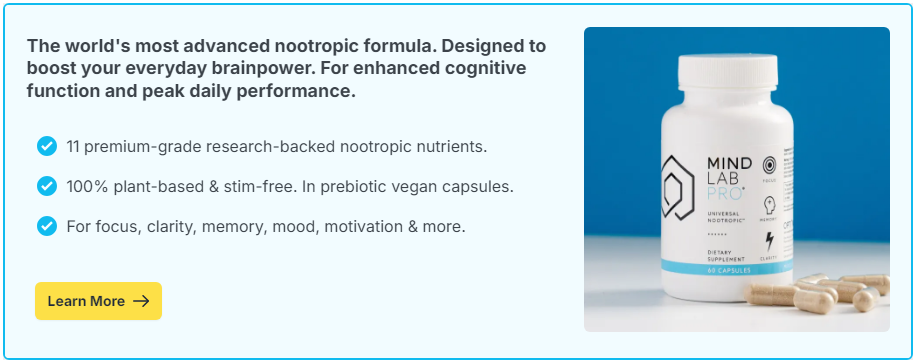
Mind Lab Pro is likely the better fit if you: prioritize knowing exactly what you’re taking and at what dose; want a formula that has been clinically tested as a complete product; prefer ingredients that are standardized to specific active compound percentages; are planning long-term daily use without cycling; or are willing to pay a modest premium for greater confidence in the formula.
Alpha Brain might appeal more if you: want a nootropic available in retail stores without ordering online; are drawn to the brand’s cultural cachet and long track record in the market; want the lower entry cost and generous return policy to try a nootropic with minimal financial risk; or specifically want the Alpha-GPC and Huperzine A acetylcholine stack that Alpha Brain is built around.
The Verdict
Alpha Brain’s longevity in the market is real, its retail availability is convenient, and its pricing is competitive. For a first-time nootropic buyer who wants to pick something up at Target and give it a try, it’s not a bad option. The two independently published clinical studies – even if partially company-funded – put it ahead of most nootropics, which have none at all.
But the proprietary blend issue is a real limitation that’s difficult to argue around. Transparency isn’t just an abstract virtue – it’s the mechanism by which buyers can have justified confidence that what’s on the label will actually do something. Mind Lab Pro answers that question directly and has the independent clinical trial record to back it up. For anyone who takes a research-first approach to supplementation, that combination is hard to match.