
Mind Lab Pro and Mind Vitality Focus represent two of the more thoughtfully assembled nootropic formulas currently on the market. Both are caffeine-free, both disclose their ingredient doses transparently, and both are priced at the lower end of the premium tier. The two products share a similar philosophy and target a similar buyer. The differences are meaningful, but they’re more nuanced than in comparisons involving proprietary blends or dramatically different price points.
Mind Vitality Focus is a newer entrant, produced by UK-based Health Nutrition Limited – a company with an established track record across the supplement space. Its formula leans heavily into the adaptogen category, emphasizing stress resilience alongside cognitive support. Mind Lab Pro, now in its fourth version, has been refined over more than a decade and remains one of the most rigorously studied nootropic formulas available. Understanding how these two products differ in practice requires a close look at what’s actually in each bottle and what the research says about those choices.
Contents
The Philosophy Behind Each Formula
Mind Lab Pro’s design philosophy is tight and deliberate: 11 ingredients, all fully dosed and disclosed, working across six cognitive bio-pathways simultaneously. Every compound earns its place by meeting a research threshold, and the formula has been validated as a whole unit in published clinical trials. The approach prioritizes depth over breadth – fewer ingredients, each present at a meaningful dose, rather than a longer list where some compounds may be token inclusions.
Mind Vitality Focus takes a broader approach, organizing its 17 ingredients around a three-pathway framework the company calls the “Ignition Tri-Factor.” The three pathways target stress reduction (the “Stress Kill Switch”), attention and focus (the “Brain Focus Matrix”), and cognitive acceleration. It’s a genuinely interesting organizational structure, and the formula does address a wider range of biological targets than Mind Lab Pro. The meaningful question – as with any nootropic – is whether the wider coverage comes at the expense of adequate dosing for each individual ingredient.
Ingredient Comparison
The two formulas share several core nootropic ingredients, including Lion’s Mane Mushroom, Bacopa Monnieri, and Rhodiola Rosea. Where they diverge most is in how each targets stress and energy: Mind Vitality leans on a robust adaptogen stack including Ashwagandha, Korean Ginseng, and Mucuna Pruriens, none of which appear in Mind Lab Pro. Mind Lab Pro counters with Citicoline, L-Theanine, and Maritime Pine Bark Extract – three evidence-backed compounds absent from Mind Vitality’s formula.
| Ingredient | Mind Lab Pro | Mind Vitality Focus | What It Does |
|---|---|---|---|
| Lion’s Mane Mushroom | 500 mg (Organic, full spectrum) | 500 mg | NGF stimulation; neuroplasticity and long-term brain health |
| Bacopa Monnieri | 150 mg (45% bacosides) | 300 mg | Memory consolidation, learning, stress reduction |
| Rhodiola Rosea | 50 mg (3% rosavins) | 250 mg | Adaptogen; mental performance under stress and fatigue |
| Phosphatidylserine (PS) | 100 mg (Sharp-PS® Green) | 100 mg | Cell membrane integrity; long-term memory support |
| N-Acetyl-L-Tyrosine | 175 mg | 250 mg | Neurotransmitter support; focus and multitasking under stress |
| Citicoline | 250 mg (Cognizin®) | No | Brain cell energy, attention, and memory formation |
| L-Theanine | 100 mg (Suntheanine®) | No | Alpha brainwave promotion; calm, focused state |
| Maritime Pine Bark Extract | 75 mg (95% proanthocyanidins) | No | Antioxidant; cerebral blood flow and oxygen delivery |
| Ashwagandha (KSM-66) | No | 250 mg | Adaptogen; cortisol reduction, stress resilience |
| Korean Ginseng (Panax) | No | 200 mg | Mental alertness, energy, and cognitive performance |
| Mucuna Pruriens | No | Yes | L-DOPA precursor; dopamine support and motivation |
| Ginkgo Biloba | No | Yes | Cerebral blood flow; memory and processing speed |
| Huperzia Serrata | No | 200 mcg | Acetylcholinesterase inhibitor; memory support (requires cycling) |
| B-Vitamin Complex | B6, B9, B12 (NutriGenesis® forms) | B1, B3, B6, B9, B12 | Homocysteine control; mood, energy, and cognitive function |
| Choline | No (covered via Citicoline) | 250 mg | Acetylcholine precursor; learning and memory |
A few things stand out from this table. First, where the products share ingredients, Mind Vitality’s doses are consistently equal to or higher than Mind Lab Pro’s – notably with Bacopa Monnieri (300 mg vs. 150 mg), Rhodiola Rosea (250 mg vs. 50 mg), and N-Acetyl-L-Tyrosine (250 mg vs. 175 mg). That’s a meaningful observation in a product category where underdosing is a chronic complaint. Second, Mind Lab Pro’s missing ingredients aren’t obscure filler compounds – Citicoline, L-Theanine, and Maritime Pine Bark are three of the most evidence-backed nootropic compounds available, and their absence from Mind Vitality’s formula represents a real gap. Third, the Huperzia Serrata issue noted in earlier comparisons applies here too: because of its long half-life, periodic cycling is advisable rather than strictly daily use.
The Adaptogen Difference
The most substantive philosophical difference between these two products is Mind Vitality’s emphasis on adaptogens. Ashwagandha, Rhodiola Rosea, Korean Ginseng, and Mucuna Pruriens are all compounds with solid research behind them for stress modulation, cortisol management, and sustained mental energy – particularly useful for people whose cognitive challenges are driven as much by chronic stress and fatigue as by raw processing limitations. Mind Lab Pro addresses stress primarily through Rhodiola Rosea and N-Acetyl-L-Tyrosine, but at lower doses and without the Ashwagandha and Ginseng backup.
For users who feel their mental performance suffers most when they’re stressed, overworked, or running on depleted reserves, the adaptogen-heavy design of Mind Vitality may be the more directly relevant formula. For users seeking broad cognitive enhancement across memory, focus, processing speed, and neuroplasticity – without a particular emphasis on stress as the primary bottleneck – Mind Lab Pro’s more even distribution across cognitive pathways may serve better.
Clinical Evidence
This is where Mind Lab Pro retains its clearest advantage. Its formula has been tested in multiple double-blind, placebo-controlled human clinical trials with results published in peer-reviewed academic journals, demonstrating statistically significant improvements in information processing speed, immediate recall, and delayed recall. These trials tested the complete formula at the doses sold to consumers – a standard of evidence that remains rare in the nootropic industry.
Mind Vitality Focus does not have published clinical trials on its complete formula. Like most nootropics, it rests its case on the research behind its individual ingredients, which is extensive for many of the compounds it uses. Ashwagandha at 250–600 mg, Bacopa at 300 mg, and Rhodiola at similar doses have all performed well in human trials individually. But ingredient-level evidence is not the same as formula-level evidence, and the honest answer is that nobody knows with clinical certainty how Mind Vitality’s specific combination performs relative to placebo. Mind Lab Pro has answered that question directly. Mind Vitality has not.
Dosage and Convenience
| Mind Lab Pro | Mind Vitality Focus | |
|---|---|---|
| Capsules per serving | 2 capsules | 3 capsules |
| Recommended schedule | Daily (no cycling required) | Daily (cycling advisable due to Huperzia Serrata) |
| Contains caffeine | No | No |
| Full ingredient transparency | Yes – all doses disclosed | Yes – all doses disclosed |
| Vegan-friendly | Yes (NutriCaps® fermented tapioca) | Yes |
| GMO-free | Yes | Yes |
| Gluten-free | Yes | Yes |
| Third-party tested | Yes | Yes (FDA-registered facility) |
Both products score well on clean formulation standards – no caffeine, no GMOs, no gluten, both vegan-friendly and fully transparent on dosing. This is one comparison where neither product has a material advantage over the other on these criteria. The three-capsule daily serving for Mind Vitality is a small step up from Mind Lab Pro’s two, but three capsules is hardly burdensome and is a reasonable trade-off for the additional ingredient coverage. The Huperzia Serrata cycling consideration is the same caveat that applies to any product containing that compound.
Price Comparison
| Mind Lab Pro | Mind Vitality Focus | |
|---|---|---|
| 1-bottle / 1-month supply | ~$69 | ~$69.99 |
| Best multi-bottle value | ~$52/month (buy 3, get 1 free) | ~$46.67/month (3 bottles for $139.99) |
| 5-bottle option | Not offered | ~$42/month (5 bottles for $209.99) |
| Money-back guarantee | 30-day performance promise | 100-day money-back guarantee |
| Cost per serving (single bottle) | ~$2.30 | ~$2.33 |
At the single-bottle level, these two products are essentially identical in price – separated by less than a dollar per month. On multi-bottle purchases, Mind Vitality actually undercuts Mind Lab Pro modestly, dropping to around $46.67 per month on the three-bottle deal versus roughly $52 for Mind Lab Pro’s best bundle. Mind Vitality also extends a significantly more generous 100-day money-back guarantee compared to Mind Lab Pro’s 30-day window, which is a meaningful benefit for anyone who wants an extended trial period before committing. Neither product has a dramatic price advantage over the other, but Mind Vitality edges ahead on long-term value and return policy generosity.
Who Should Choose Which?
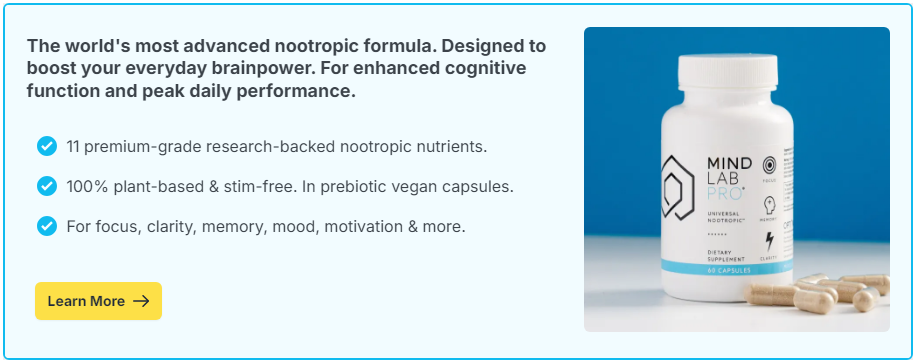
Mind Lab Pro is likely the better fit if you: want a formula validated by independent human clinical trials on the complete product; prioritize Citicoline and L-Theanine as core nootropic compounds; prefer a two-capsule daily routine with no cycling considerations; or want the most research-validated nootropic stack available at this price point.
Mind Vitality Focus may be the stronger choice if you: experience cognitive decline that is heavily tied to stress, fatigue, or burnout rather than purely to processing limitations; want a richer adaptogen profile including Ashwagandha and Korean Ginseng; prefer higher doses of shared ingredients like Bacopa and Rhodiola; or want the more generous 100-day return policy for a longer trial window.
The Verdict
Both products are transparent, well-formulated, caffeine-free, and fairly priced. Neither is cutting corners in ways that should concern a buyer. The choice between them comes down to which gaps matter more to you.
Mind Lab Pro’s gap is in the adaptogen and stress-resilience department – it’s lighter on those compounds than Mind Vitality and lacks the Ashwagandha and Ginseng stack entirely. Mind Vitality’s gap is in clinical validation and two foundational nootropic compounds: Citicoline and L-Theanine, which are among the best-studied brain-boosters available and simply aren’t in the formula. For most people seeking broad cognitive support with the highest possible evidence base behind it, Mind Lab Pro remains the more defensible recommendation. For those whose daily mental challenges are rooted specifically in stress and burnout, Mind Vitality’s adaptogen depth makes it a genuinely compelling alternative worth serious consideration.