
Of the many brain supplement comparisons, the Mind Lab Pro versus NooCube matchup may generate the most genuine debate. Both products are caffeine-free, both are fully transparent about ingredient doses, both are priced within a few dollars of each other per month, and both are regularly cited near the top of independent nootropic rankings. There is no glaring structural flaw in either formula – no hidden blends, no obvious deal-breakers – which means the comparison comes down to genuine differences in formulation philosophy and the weight you put on different types of evidence.
NooCube is produced by Wolfson Brands, a UK-based supplement company also behind TestoPrime and Crazy Nutrition. It is currently in its third version (v3.0), with recent formula revisions removing ingredients containing soy and gluten. Its 12-ingredient formula takes an interesting angle by including Lutemax 2020, a proprietary carotenoid blend primarily associated with eye health but with emerging research linking it to broader cognitive and neurological benefits. Mind Lab Pro, now in v4, has been refined over more than a decade and has a very robust clinical trial record. How these two products differ in practice is worth examining closely.
Contents
The Philosophy Behind Each Formula
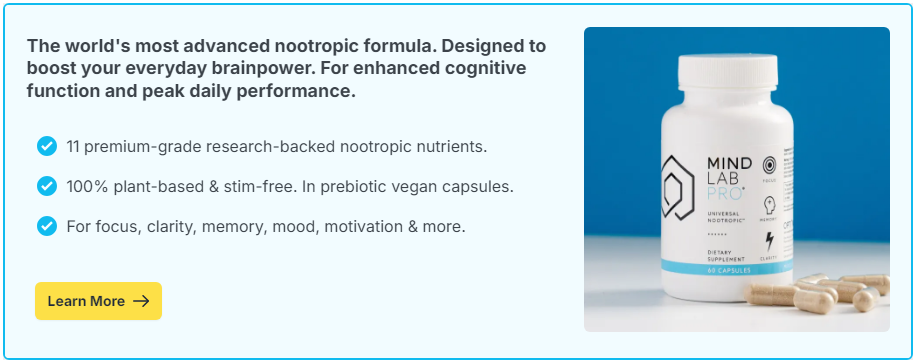
Mind Lab Pro’s design ethos is precision over breadth. Its 11 ingredients are chosen for the depth of research behind each compound and the quality of the specific forms used – patented, standardized versions like Cognizin® Citicoline, Sharp-PS® Green Phosphatidylserine, and Suntheanine® L-Theanine. The formula is validated not just ingredient by ingredient but as a complete unit in independent human clinical trials, which is the standard of evidence the company has built its reputation on.
NooCube takes a somewhat broader approach across its 12 ingredients, targeting memory, focus, stress, and – unusually for a nootropic – visual processing and brain-eye health through the inclusion of Lutemax 2020. The company describes the formula as crafted with the input of top European neuroscientists, and it emphasizes transparency: no proprietary blends, all doses fully disclosed. Like Mind Lab Pro, NooCube contains no caffeine or stimulants of any kind, positioning itself as a clean daily-use product rather than an energy supplement in disguise.
Ingredient Comparison
Both formulas share a meaningful set of core nootropic compounds, though often at different doses and in different forms. The table below covers the most clinically significant ingredients in each product and highlights where they diverge.
| Ingredient | Mind Lab Pro | NooCube | What It Does |
|---|---|---|---|
| Bacopa Monnieri | 150 mg (45% bacosides) | 250 mg | Memory consolidation, learning, anxiety reduction |
| L-Theanine | 100 mg (Suntheanine®) | 100 mg | Alpha brainwave promotion; calm, focused state |
| L-Tyrosine | 175 mg (N-Acetyl-L-Tyrosine) | 250 mg | Neurotransmitter support; focus and multitasking under stress |
| Citicoline | 250 mg (Cognizin®) | No | Brain cell energy, attention, and memory formation |
| Phosphatidylserine (PS) | 100 mg (Sharp-PS® Green) | No | Cell membrane integrity; long-term memory support |
| Lion’s Mane Mushroom | 500 mg (Organic, full spectrum) | No | NGF stimulation; neuroplasticity and long-term brain health |
| Rhodiola Rosea | 50 mg (3% rosavins) | No | Adaptogen; mental performance under stress and fatigue |
| Maritime Pine Bark Extract | 75 mg (95% proanthocyanidins) | No | Antioxidant; cerebral blood flow and oxygen delivery |
| Alpha-GPC | No | 50 mg | Choline precursor; learning, memory, and acetylcholine support |
| Huperzine A | No | 20 mg | Acetylcholinesterase inhibitor; memory support (requires cycling) |
| Lutemax 2020 (Lutein/Zeaxanthin) | No | 20 mg | Eye health; also linked to BDNF increase and reduced mental fatigue |
| Resveratrol | No | 14.3 mg | Antioxidant; supports cerebral blood flow and neuroprotection |
| Pterostilbene | No | 140 mcg | Antioxidant; enhanced bioavailability analog of resveratrol |
| Panax Ginseng | No | 20 mg | Mental alertness, energy, and cognitive performance |
| B-Vitamins | B6, B9, B12 (NutriGenesis® forms) | B1, B7, B12 | Homocysteine control; neurological function and brain energy |
The most striking observation from this table is that Mind Lab Pro’s four absent-from-NooCube ingredients – Citicoline, Phosphatidylserine, Lion’s Mane Mushroom, and Rhodiola Rosea – are among the most rigorously studied nootropic compounds available. Their absence from NooCube is a genuine gap. Citicoline and Phosphatidylserine in particular are foundational to Mind Lab Pro’s memory and brain cell support profile, and Lion’s Mane’s evidence base for neuroplasticity and nerve growth factor stimulation is unusually robust for a natural compound.
In the other direction, NooCube’s unique inclusions are genuinely interesting. Lutemax 2020 is not simply a marketing gimmick – clinical research has linked it to improvements in BDNF (brain-derived neurotrophic factor), reduced stress markers, and better sleep quality alongside its eye health benefits. For people who spend long hours in front of screens, the cognitive-visual health angle has real relevance. The Alpha-GPC and Huperzine A pairing also creates a meaningful acetylcholine support stack, though both are at doses on the lower end of what research studies typically use, and Huperzine A’s half-life accumulation issue applies here as it does with any product containing it.
The Dosing Question
NooCube’s most significant vulnerability as a formula is one it shares with much of the nootropic industry: several ingredients are present at doses meaningfully below the thresholds at which clinical studies observe significant effects. Panax Ginseng is included at 20 mg while studies on its acute cognitive effects typically use 100 to 600 mg. L-Tyrosine is included at 250 mg while research on its performance under stress typically uses doses nearer to 2,000 mg. Even Bacopa Monnieri at 250 mg sits somewhat below the 300 mg dose that most positive memory studies use.
This is not unique to NooCube, and Mind Lab Pro is not entirely exempt from similar scrutiny. But Mind Lab Pro’s use of patented, standardized ingredient forms – where a smaller absolute dose may be more bioavailable than a generic equivalent – and the fact that its complete formula has been tested in human trials at the doses sold gives it a materially stronger evidentiary position. With NooCube, the honest answer is that some ingredients are likely contributing meaningfully and others may be present more for label completeness than for dose-appropriate efficacy.
Clinical Evidence
Mind Lab Pro has been tested in multiple independent, double-blind, placebo-controlled human clinical trials, with results published in peer-reviewed academic journals. These studies demonstrate statistically significant improvements in information processing speed, immediate recall, and delayed recall – using the actual product at its commercial doses. This is the gold standard for supplement evidence and it remains genuinely rare in the nootropic category.
NooCube does not have published clinical trials on its complete formula. Its case rests on ingredient-level research, which for several of its compounds – Bacopa, L-Theanine, Alpha-GPC – is substantial. The company also emphasizes significant investment in third-party testing to verify that label claims are accurate, which is a meaningful quality control commitment even if it is not the same as a clinical trial on the formula’s effectiveness. For a buyer making a purely evidence-based decision, Mind Lab Pro’s clinical trial record remains its clearest competitive advantage across all brain supplements.
Dosage and Convenience
| Mind Lab Pro | NooCube | |
|---|---|---|
| Capsules per serving | 2 capsules | 2 capsules |
| Recommended schedule | Daily (no cycling required) | Daily (cycling advisable due to Huperzine A) |
| Contains caffeine | No | No |
| Full ingredient transparency | Yes – all doses disclosed | Yes – all doses disclosed |
| Vegan-friendly | Yes (NutriCaps® fermented tapioca) | Yes |
| GMO-free | Yes | Yes |
| Gluten-free | Yes | Yes (reformulated in v3.0) |
| Soy-free | Yes | Yes (reformulated in v3.0) |
| Third-party tested | Yes | Yes (extensive batch testing) |
| Free worldwide shipping | On orders over $100 | Yes, on all orders |
On daily convenience, these are closely matched products. Both require two capsules per day, both are caffeine-free, and both have strong clean-formulation credentials. NooCube holds a slight practical edge with free worldwide shipping on all orders regardless of size – something Mind Lab Pro only offers above the $100 threshold. The Huperzine A cycling caveat applies to NooCube as it does to all products containing this compound; periodic cycling is advisable even though Wolfson Brands recommends daily use.
Price Comparison
| Mind Lab Pro | NooCube | |
|---|---|---|
| Single bottle (1-month supply) | ~$69 | ~$64.99 |
| Best multi-bottle price per month | ~$52/month (buy 3, get 1 free) | ~$39/month (5-month bundle for ~$195) |
| Subscription option | No (bundle discounts only) | No (bulk purchase only) |
| Money-back guarantee | 30-day performance promise | 60-day money-back guarantee |
| Free worldwide shipping | Orders over $100 | All orders |
NooCube’s pricing structure is one of its strongest arguments. At the single-bottle level it undercuts Mind Lab Pro by around $4. But the real story is the bulk pricing: NooCube’s five-month supply brings the cost down to approximately $39 per month, compared to Mind Lab Pro’s best-deal equivalent of around $52 per month. For a buyer committed to long-term supplementation – which is genuinely when the evidence for these compounds suggests the strongest benefits accumulate – that gap represents a saving of well over $150 per year. Neither product offers a subscription model; both require upfront bulk purchases to unlock the best per-bottle price.
Who Should Choose Which?
Mind Lab Pro is likely the better fit if you: want the most clinically validated nootropic formula available at this price point; prioritize Citicoline, Phosphatidylserine, and Lion’s Mane as core compounds; are focused especially on long-term memory and neuroplasticity support; or want a formula where the complete product – not just individual ingredients – has been independently tested in human trials.
NooCube may be the stronger choice if you: spend significant time in front of screens and want cognitive support that also addresses visual processing and eye fatigue; are price-sensitive and planning to supplement long-term, where NooCube’s bulk pricing provides meaningful savings; are interested in the BDNF and sleep quality benefits associated with Lutemax 2020; or prefer the more generous 60-day return window and free worldwide shipping on every order.
The Verdict
NooCube is one of the best-constructed nootropic formulas at its price point, and its advantages – complete transparency, no proprietary blends, Lutemax 2020, competitive bulk pricing, free global shipping, and a 60-day guarantee – are all real. For buyers who are heavy screen users, or those planning a sustained multi-month commitment who want to keep costs manageable, it makes a genuinely compelling case.
But the absences in NooCube’s formula are difficult to argue around for buyers who take an evidence-first approach. Citicoline, Phosphatidylserine, Lion’s Mane Mushroom, and Rhodiola Rosea are four of the most research-backed cognitive compounds available, and none of them are in the bottle. Several of NooCube’s included ingredients are also likely underdosed relative to effective clinical benchmarks. Mind Lab Pro’s premium buys you those four compounds in well-dosed forms and – most distinctively in this entire category – a formula that has been independently proven to improve cognitive performance in peer-reviewed human trials. For buyers where that standard of evidence matters most, it remains the more defensible choice.