

There’s a particular kind of clarity that tends to arrive sometime in your fifties. Not the foggy kind you’ve been reading about, but the clearer-eyed variety: the recognition that the brain you’ve been running hard for five decades deserves some deliberate maintenance. You wouldn’t drive a well-loved car another hundred thousand miles without checking the fluids. The same logic applies here, and the good news is that the science of what actually helps has matured considerably in recent years.
If you’re over fifty and considering brain supplements for the first time, this guide is built around your specific situation. Not the general nootropic conversation aimed at twenty-five-year-old software developers optimizing for peak productivity, but the more grounded, more consequential question of how to support a brain that’s been around long enough to know what it’s doing and deserves the conditions to keep doing it well.
Contents
What Actually Changes in the Brain After 50
Understanding what’s happening gives you a much clearer sense of what’s worth addressing. The changes in the aging brain are real but they’re also more gradual, more specific, and more modifiable than popular culture tends to suggest.
Cerebral blood flow decreases modestly with age, meaning neurons receive slightly less oxygen and glucose than they once did. The production of key neurotransmitters, including acetylcholine, dopamine, and serotonin, becomes less efficient. Myelin, the protective sheath around nerve fibers that enables fast signal transmission, shows wear in some regions. The brain’s ability to generate new neurons, neurogenesis, slows but does not stop. And the cellular repair and waste-clearance systems that keep brain tissue healthy become somewhat less efficient, meaning oxidative stress and inflammation accumulate more readily than they did at thirty.
What This Means in Practice
These changes don’t announce themselves as dramatic failures. They tend to show up as subtleties: words retrieved a beat more slowly, names that take an extra moment, a slightly reduced tolerance for cognitive multitasking, and a sharper awareness of what good mental energy feels like because its absence is now more noticeable. None of this is inevitable deterioration. Much of it is responsive to targeted support, which is precisely what a well-chosen supplement protocol can provide.
The Foundation Has to Come First
Before any supplement does its best work, the basics need to be reasonably in order. This is not a disclaimer designed to hedge. It’s a practical observation about how the aging brain responds to inputs. A supplement that supports acetylcholine production, for instance, works considerably better in a brain that’s getting enough sleep to actually synthesize and use that acetylcholine effectively. The two things work together, not independently.
Aerobic exercise remains the single most evidence-backed intervention for age-related cognitive change. It stimulates Brain-Derived Neurotrophic Factor, supports hippocampal neurogenesis, improves cerebral blood flow, and reduces the inflammatory burden on brain tissue. Thirty minutes of moderately intense aerobic activity most days of the week is a dose that consistently shows up in the research as cognitively meaningful. Sleep quality, dietary quality broadly along Mediterranean lines, and active stress management round out a foundation that makes everything else more effective.
Why Supplementation Makes Particular Sense After 50
Here’s where the calculus shifts for the over-fifty group specifically. In younger adults, a genuinely good diet and healthy lifestyle can largely meet the brain’s nutritional needs without supplementation. After fifty, several factors change that calculation. Nutrient absorption efficiency declines with age, meaning dietary intake and actual cellular availability diverge more than they once did. The specific neurochemical and structural demands of an aging brain, particularly around phospholipids, antioxidant protection, and neurotransmitter precursors, increase at the same time that the body’s ability to meet those demands decreases. And the timeline for prevention is significantly more favorable than the timeline for recovery, meaning that supporting brain health now, before significant decline occurs, is substantially more effective than attempting to reverse decline later.
Ingredients That Matter Most for the Over-50 Brain
With the market being as crowded and inconsistent as it is, narrowing to the ingredients with the strongest research relevance for age-related cognitive change is a useful starting point. These are the compounds where the science is most developed and most applicable to what’s actually happening in the brain after fifty.
Citicoline for Brain Energy and Cell Membrane Health
Citicoline, particularly in its Cognizin patented form, supports the synthesis of phosphatidylcholine, a phospholipid that forms a critical structural component of brain cell membranes. As membrane integrity declines with age, so does the efficiency of neural signaling. Citicoline also supports mitochondrial function in neurons, which directly affects the brain energy available for cognitive tasks. Studies using Cognizin specifically have shown improvements in attention and processing speed in older adults, making it one of the more directly relevant ingredients for the over-fifty cohort.
Phosphatidylserine for Memory and Cognitive Sharpness
Phosphatidylserine is a phospholipid naturally concentrated in brain cell membranes, and its levels decline measurably with age. Supplementation has been studied specifically in older adults for its effect on memory, learning rate, and mental sharpness, with enough positive findings that the US Food and Drug Administration has permitted a qualified health claim for phosphatidylserine and cognitive function reduction in older individuals. That’s an unusually substantive regulatory acknowledgment in a space where most claims go unverified.
Lion’s Mane Mushroom for Neurological Maintenance
Lion’s Mane Mushroom contains hericenones and erinacines, compounds that stimulate the synthesis of Nerve Growth Factor. NGF plays a central role in the maintenance, repair, and regeneration of neurons, and its production declines with age. Research in older adults has shown promising results for memory and mild cognitive improvements with consistent Lion’s Mane use, and its neuroprotective profile makes it particularly well-suited to a preventive brain health strategy rather than a crisis-response one.
Bacopa Monnieri for Memory Consolidation
Bacopa Monnieri’s clinical research record includes several trials conducted specifically in adults over fifty, making it one of the few botanical nootropics with age-specific evidence rather than general population data being extrapolated. Its effects on memory consolidation and retrieval speed are the best documented of any botanical cognitive ingredient, and its antioxidant activity in hippocampal tissue adds a neuroprotective dimension relevant to the aging brain’s increased vulnerability to oxidative stress.
Maritime Pine Bark Extract for Cerebral Blood Flow
Given that reduced cerebral blood flow is one of the more significant age-related changes affecting cognitive performance, an ingredient that addresses that specific mechanism directly is worth including. Maritime Pine Bark Extract is a potent antioxidant that supports the health of cerebral blood vessels and promotes healthy blood flow to brain tissue. Better blood flow means better oxygen and glucose delivery to neurons, which translates to more available mental energy and sharper cognitive performance.
Why a Comprehensive Formula Makes More Sense Than Single Ingredients
The aging brain isn’t experiencing one problem. It’s experiencing several interacting changes simultaneously, each affecting different aspects of cognitive function through different mechanisms. An approach that addresses cerebral blood flow but ignores neurotransmitter support, or that targets memory but overlooks neuroprotection, is addressing one thread of a multi-threaded challenge.
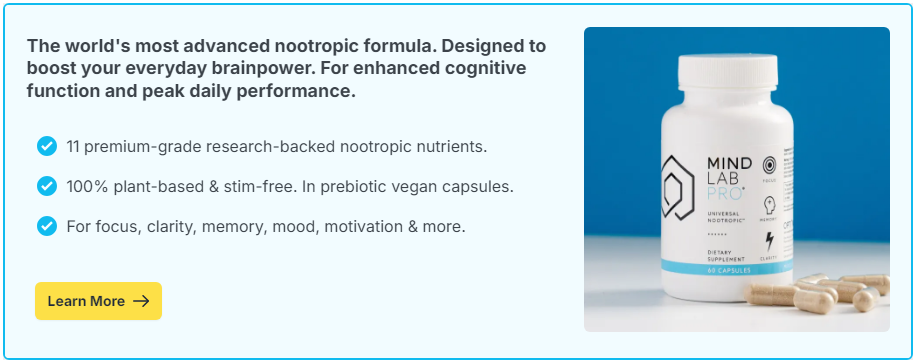
This is the strongest argument for a comprehensive, well-formulated nootropic over a collection of individual supplements, and it’s the argument that makes Mind Lab Pro particularly worth considering for the over-fifty reader. All five of the ingredients discussed above are present in Mind Lab Pro’s eleven-compound formula, alongside L-Theanine for calm focus, Rhodiola Rosea for stress resilience and mental fatigue, Vitamin B6, B9, and B12 in bioavailable forms for homocysteine regulation and neurotransmitter synthesis support, and N-Acetyl L-Tyrosine for dopamine and norepinephrine precursor support.
That breadth of coverage isn’t padding. It reflects the genuine complexity of age-related cognitive change and the reality that meaningful support requires addressing multiple systems rather than optimizing one while leaving others unattended. The formula is also free of stimulants and synthetic additives, which matters more in the over-fifty context where interactions with medications and sensitivity to stimulants are more common considerations.
Setting Realistic Expectations and a Sensible Timeline
The most common mistake people make when starting brain supplements at any age is evaluating them on too short a timeline. For the over-fifty brain, the most relevant ingredients, Bacopa, Lion’s Mane, Phosphatidylserine, work through mechanisms that require weeks to months of consistent supplementation before their effects become clearly perceptible. This is a feature, not a limitation. It reflects genuine structural and neurochemical change rather than the temporary stimulant effect that fades as quickly as it arrives.
A sensible approach is to commit to a consistent three-month trial, taken alongside the behavioral foundations of sleep, exercise, and diet, and to note cognitive experience in a simple weekly log. By the end of that period, most people who have approached it this way report clear and genuine improvements in mental sharpness, word retrieval, focus duration, and the overall sense of cognitive ease that tends to quietly erode before people notice it’s gone.
The brain at fifty, sixty, or beyond is not a diminished version of what it once was. In many respects, it’s a more capable and more richly connected organ than it was at twenty-five. What it benefits from is thoughtful maintenance, the kind that acknowledges the specific changes underway and responds to them with targeted, evidence-grounded support. That’s a very achievable goal, and starting now, rather than later, is the most consequential decision in the whole process.