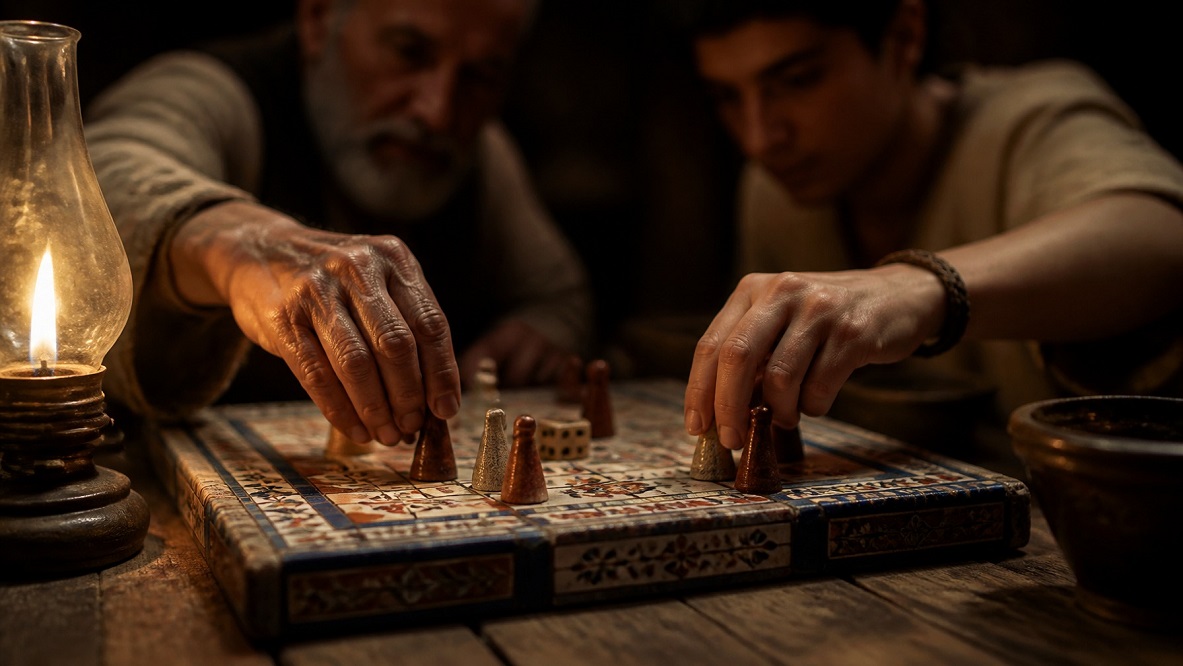
Ancient board games reveal that strategic thinking is old, widespread, and fun. People have spent thousands of years practicing planning, risk assessment, and reading opponents on boards of wood, stone, and ivory. The roughly 4,600-year-old Royal Game of Ur mixes dice luck with tactical choices, and that blend still trains the same skills. Games may be humanity’s oldest low-stakes strategy gym.
The Royal Game of Ur
According to a Getty educational guide, the game is about 4,600 years old, based on a board found in Ur in Mesopotamia, in modern Iraq. It was excavated from a royal cemetery, but the game was popular at all levels of society.
It is a race game on a 20-square board. Each player has seven pieces, and the first to move all of them off the board wins. A later, more complex version was partly described on a cuneiform tablet in the British Museum, which Irving Finkel deciphered and used to reconstruct a version we can play today.
Luck, Odds, and Risk
The rules create real decisions. Players roll dice, and only 1 to 4 count. Pieces may need an exact roll to leave the board. An opponent can capture a lone piece on the central bridge, sending it back to the start, while paired pieces are safe. Landing on a marked square grants an extra roll.
Each turn forces a risk judgment. Do you advance a leading piece into danger, bring a new one on, or keep a safe formation? Players quickly learn to think in probabilities even without naming them.
Other Ancient Games, Other Skills
Different games train different muscles. Senet, an Egyptian game found in tombs including Tutankhamun’s, was a race with luck and tactics, and it later took on afterlife symbolism. Go, which originated in China more than 2,000 years ago, has no luck at all and rewards long-range planning. Norse tafl games pit a besieged king against attackers, which forces each side to think in a completely different way.
Taken together, ancient games ran from pure chance to pure strategy, with many hybrids between. Players clearly enjoyed testing both luck and skill.

What Strategy Does to the Brain
Strategy games ask several mental systems to cooperate. Working memory holds the position. Planning looks ahead. Inhibition resists the tempting but weak move. And theory of mind, the ability to predict what your opponent is thinking, anticipates the reply.
Research on chess experts, going back to the 1970s, found that masters recall board positions by chunking pieces into meaningful patterns, not by memorizing each piece. It is reasonable to expect that skilled players of ancient games did something similar. We do not have evidence that playing makes anyone generally smarter, but it clearly trains those specific skills.
Why Games Might Be Practice for Life
Games compress real challenges into a safe space: allocating limited resources, handling uncertainty, bluffing, sacrificing now for later. A player loses a piece and learns something without losing a harvest. That is an inference, but it fits the long history of games across cultures, often tied to ritual, diplomacy, and social bonding.
Play Like an Ancient Strategist
Here are a few ways to turn play into practice:
- Try a simple race game and name each risk before you move.
- Before each turn, predict your opponent’s reply.
- After a loss, find the single decision that mattered most.
- Learn a pure strategy game, such as Go or checkers, to practice planning ahead.
Strategy, Focus, and Where Nootropics Fit
Strategic play takes sustained attention and a clear head. Curious readers sometimes ask about nootropics, supplements marketed for focus and memory. Evidence varies widely by ingredient, and no capsule replaces practice or sleep.
Frequently Asked Questions
How Old Is the Royal Game of Ur?
About 4,600 years old, according to a Getty educational guide, based on a board excavated from a royal cemetery in Ur.
Do Board Games Improve Thinking?
They clearly exercise planning, memory, and prediction. This article does not cite evidence that they make people generally smarter.
Which Ancient Game Is Best for Strategy?
Go is a strong choice because it removes luck entirely and rewards long-range planning. Hybrid games like Ur add risk management.