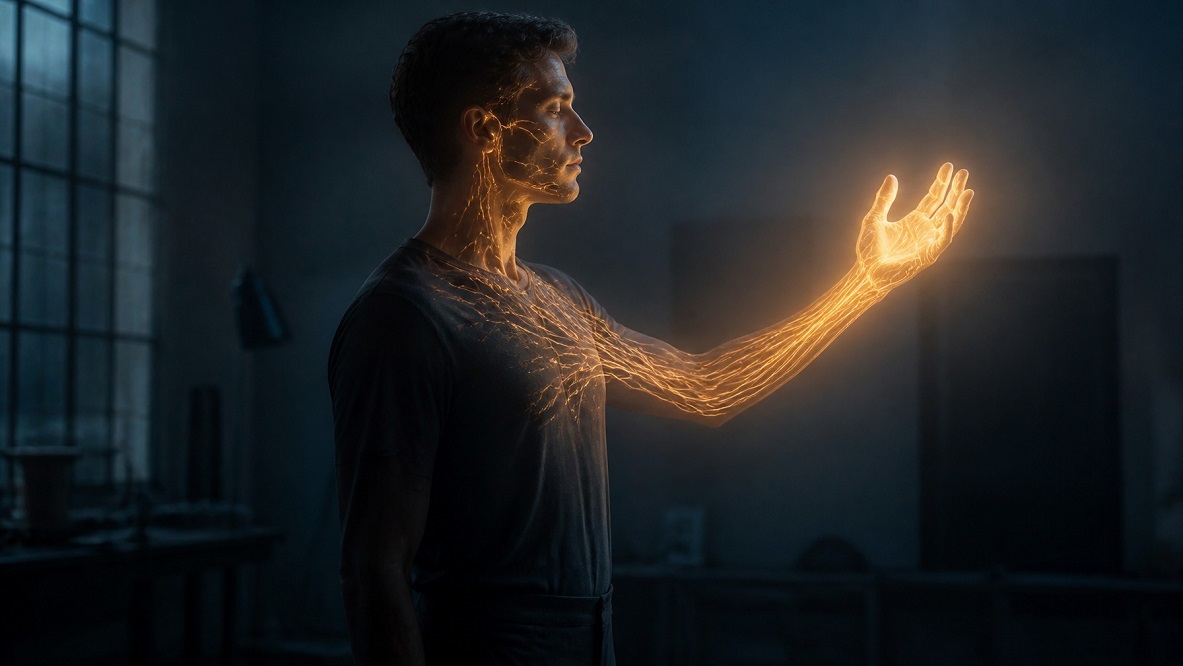
Phantom limbs reveal that your sense of your body lives in the brain, not in the body itself. After an amputation, many people still feel the missing limb, because the brain’s internal map of the body does not vanish when the nerves are cut. Researchers have also found that this map can reorganize, which explains some of the strangest sensations. Phantoms are a window into how the brain builds the feeling of having a body.
A Missing Limb That Still Feels Present
Roughly half or more of amputees report phantom sensations, according to commonly cited estimates, and these can include tingling, pressure, a sense of posture, or pain. Some people feel a hand clenched tightly. Others feel a foot that seems to point in an awkward direction.
For a long time, doctors suspected irritated nerve endings in the stump. That explanation fits some cases but leaves a puzzle: people born without a limb can sometimes feel a phantom too. Something in the brain must be producing the sensation.
The Brain’s Body Map
The surface of the brain’s sensory cortex holds a map of the body, often drawn as a distorted figure called the homunculus. Each body part has its own patch, and sensitive areas such as the hands and lips get generous space. Touch your finger, and the matching patch lights up.
The map has an odd layout. On it, the hand sits next to the face. That neighborhood turned out to matter a great deal.
When the Map Redraws Itself
Neuroscientist V. S. Ramachandran proposed that when input from a missing limb stops, neighboring cortical regions can expand into the quiet territory. In early experiments in the 1990s, he and colleagues reported that stroking the face of some amputees produced sensations in the phantom hand. Because the face and hand patches are adjacent, the neighboring region seemed to be driving the hand’s old territory.
The picture is more complicated today, and researchers still debate how much remapping explains phantom pain. But the central lesson holds up well: the brain’s body map is not fixed. It adjusts to the input it receives.

Mirror Therapy and Visual Tricks
Ramachandran also developed the mirror box in the 1990s. A mirror is placed so that the intact limb appears to be the missing one. When the person moves the real hand, the brain sees what looks like the phantom hand moving, and the clenched feeling can ease.
Some patients reported lasting relief, though results vary, and mirror therapy is not a guaranteed treatment. Anyone dealing with phantom pain should talk with a clinician. The broader point is fascinating on its own: vision can overrule an expectation held by the body map, which shows how much perception is negotiated among the senses.
The Body Illusions You Can Try
You can glimpse the same flexibility without losing a limb. The rubber hand illusion is a classic demonstration. Researchers hide a person’s real hand, place a rubber one in view, and stroke both at the same time. Many people begin to feel the rubber hand as their own. Here are two safe things to try with a willing friend:
- Sit with one hand hidden under a cloth while a fake hand sits in view, and have a friend stroke both in sync.
- Close your eyes and try to touch your nose, noticing how well you know where your hand is.
These experiments show that the feeling of ownership is built from sight, touch, and expectation. It is a model, and models can be updated.
Body Maps, Learning, and Where Nootropics Fit
The brain’s capacity to reorganize is a reminder that learning and adaptation continue throughout life. Curious readers sometimes ask about nootropics, supplements marketed for focus and memory. Evidence varies widely by ingredient, and no capsule replaces rehabilitation, practice, or sleep.
Frequently Asked Questions
What Causes Phantom Limb Sensations?
The brain’s body map continues to represent the missing limb, and the map can also reorganize after input is lost. Researchers still debate exactly how much each factor contributes.
Why Would Touching the Face Feel Like Touching a Missing Hand?
In the brain’s body map, the face and hand areas sit side by side. Ramachandran proposed that the face area can expand into the quiet hand area, so face touch triggers hand sensations.
Does Mirror Therapy Work?
Some patients report relief, but results vary. Talk with a clinician about phantom pain, because treatment depends on the individual.