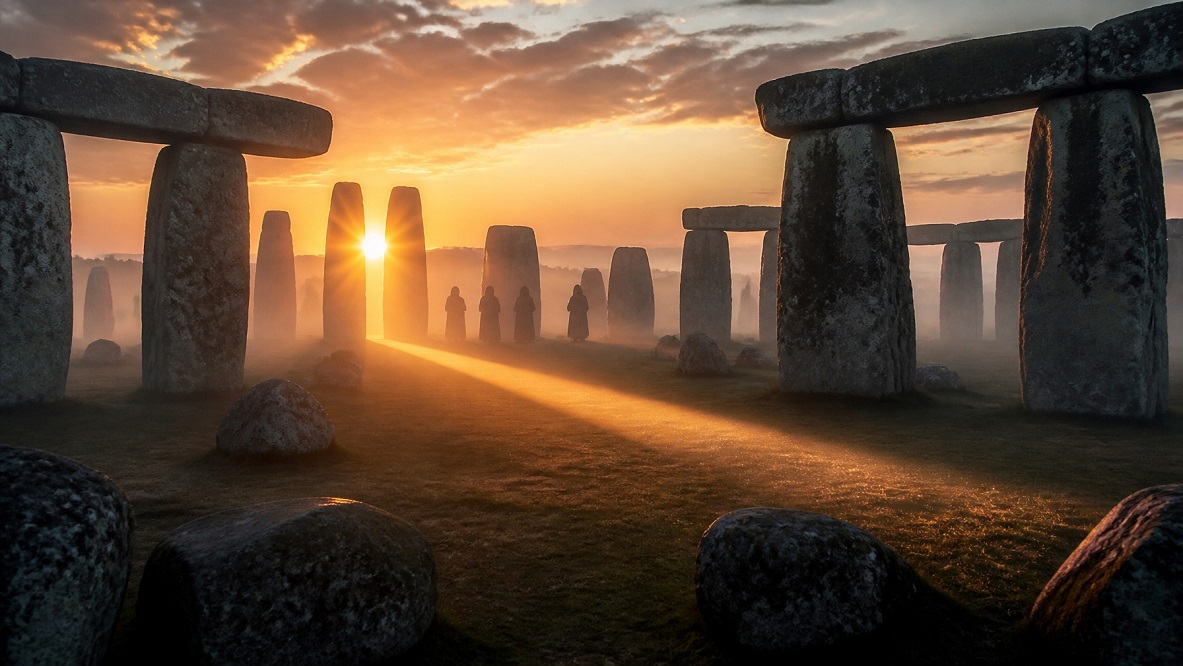
Ancient builders aligned monuments with the sky likely because the sky offers the most reliable pattern humans can see, and the brain is built to notice and exploit patterns. Sunrises and sunsets shift in a repeating cycle, so anyone who watched carefully could predict the seasons. Alignments turned that pattern into architecture. Some claimed alignments are probably coincidence, which makes the genuine ones more interesting.
The Sky as a Clock
Over a year, the point on the horizon where the sun rises moves steadily north and then south, and the same happens at sunset. It reaches its farthest points at the solstices. The word comes from Latin roots meaning the sun stands still, because the sunrise appears to pause before reversing.
That makes the solstice an unusually clear event to watch for. Anyone who marked the sunrise spot from a fixed position could tell the season to within a few days, long before written calendars existed.

Stonehenge and the Solstice Line
The best-known example is Stonehenge. According to English Heritage, the monument was built to align with the sun at the solstices. At the summer solstice, the sun rises behind the Heel Stone on the north-east horizon, and its first rays shine into the heart of the monument. At the winter solstice, the sun sets to the south-west of the stone circle. The stones have marked the winter solstice for thousands of years.
Other Monuments, Same Idea
Similar ideas appear elsewhere. Newgrange, a passage tomb in Ireland about 5,000 years old, is often described as admitting winter solstice sunrise light into its inner chamber. The Great Pyramid at Giza is oriented remarkably close to the cardinal directions. At Chichen Itza, the stepped pyramid known as El Castillo is famous for a shadow that appears to slither down its stairway around the equinoxes.
These examples vary in how well they are documented, and scholars debate the details. The shared theme is that builders cared about specific moments in the solar year and made the buildings mark them.

Why Pattern Recognition and Attention Matter
The brain constantly searches for regularity because regularity predicts what happens next. Attention tends to lock onto extremes and turning points, and a solstice is both. A monument then acts as external memory: a stone calendar that survives longer than any individual watcher.
It is reasonable to think that practical stakes sharpened the interest. Knowing when to plant, when herds might arrive, or when a ritual should occur rewards anyone who tracks the sky. That is an inference, though, and monuments probably served social and spiritual purposes alongside practical ones.
The Skeptic’s Corner
The same pattern-seeking brain can also deceive us. A monument with many lines, and a sky with many bright objects, will inevitably match something. Researchers who study ancient astronomy therefore look for strong cases: precise alignments, repeated across sites, at moments that mattered like solstices and equinoxes. When you read about a mysterious star alignment, ask how many other alignments could have been claimed and weren’t.
The checking habit is itself good brain exercise, because it asks you to separate a real pattern from one you wish were true.
Watch the Sky Like a Builder
You can try the ancient method with no equipment:
- Mark where the sun sets from a fixed spot once a month.
- Note the date it reaches its farthest north or south point.
- Use a stick and its shadow to track the sun’s movement during the day.
- Predict next month’s mark before you check it.
Attention, Patterns, and Where Nootropics Fit
Long-term sky watching rewards patience and attention. Curious readers sometimes ask about nootropics, supplements marketed for focus and memory. Evidence varies widely by ingredient, and no capsule replaces curiosity or practice.
Frequently Asked Questions
Did Stonehenge Align With the Solstices?
According to English Heritage, it was built to align with the sun at the solstices. At the summer solstice the sun rises behind the Heel Stone, and at the winter solstice it sets to the south-west.
Are All Ancient Alignments Intentional?
No. A monument with many lines and a sky with many objects can match by chance, so researchers look for precise, repeated alignments tied to meaningful events.
Why Did Ancient People Care About the Sky?
Plausibly for timekeeping, seasonal planning, and ritual, though the reasons likely varied by culture and site.