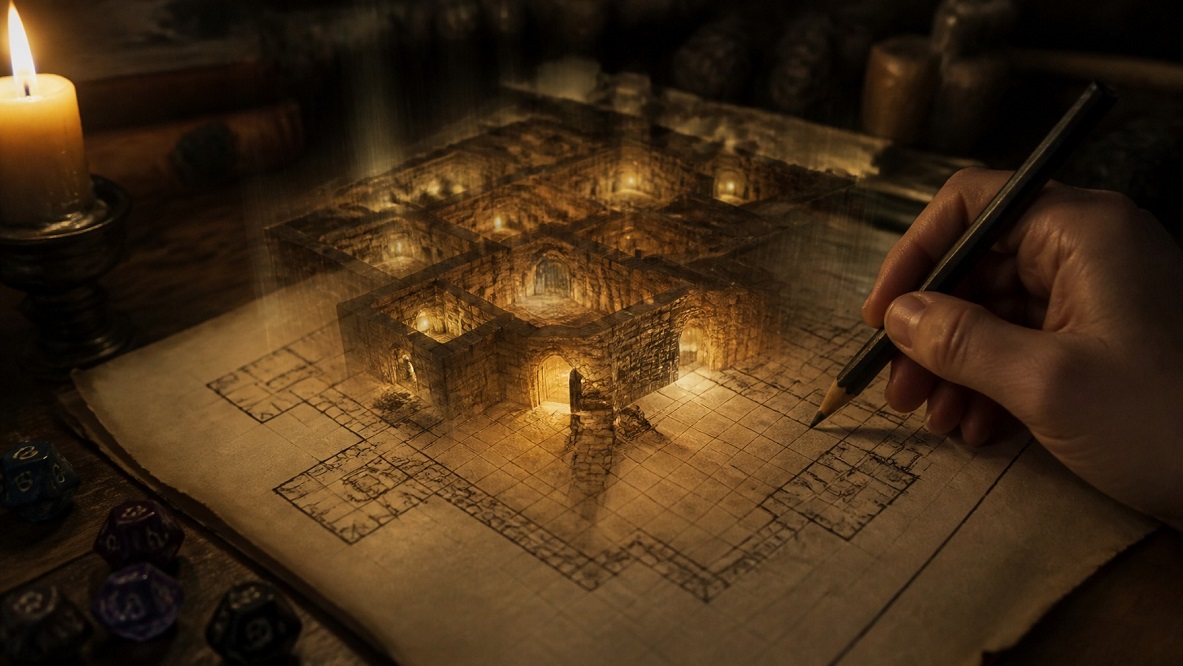
Mapping an imaginary dungeon exercises spatial memory because you must turn spoken descriptions into a mental layout, hold it in mind, and update it as you explore. The brain already does this in real places using a network built around the hippocampus. Drawing a dungeon on graph paper is plausibly a fun, low-risk way to use that machinery, though no study has tested it directly.
Words Into Space
In classic dungeon-crawling games, the game master describes a scene: a corridor runs thirty feet north, then a door opens on the east wall. One player, the mapper, listens and draws. The map is built entirely from language.
That translation is harder than it sounds. Words arrive in a line, one after another, but space is spread out in two dimensions. The mapper must convert a sequence of descriptions into a picture, correct mistakes when a later detail contradicts an earlier one, and keep the whole thing consistent.

The Brain’s Map-Making Machinery
Psychologist Edward Tolman introduced the term cognitive map in 1948 after experiments in which rats, having explored a maze, could still find food when started from different places. The finding suggested they had built an internal map, not just memorized fixed turns.
Later work tied this to specific cells. As the Karolinska Institutet summarized for the 2014 Nobel Prize, John O’Keefe found hippocampal cells that fire at specific locations, and May-Britt and Edvard Moser identified grid cells that form a coordinate system for positioning and pathfinding. Together, they help animals know where they are and where they are going.
Does Imagination Use the Same Tools?
Here the science becomes more speculative. Researchers have studied how the brain handles imagined and remembered places, and this article does not cite a particular result for fantasy dungeons. But it’s reasonable to expect that picturing a layout from a description draws on similar spatial systems, since the task is to build a map of somewhere you are not standing.
The dungeon mapper adds a twist. They never see the place at all. Everything comes from words, memory, and inference, which makes the exercise closer to reading a route description than walking a route.

What the Mapper Practices
Several distinct skills are at work:
- Holding the current layout in working memory while listening to the next description.
- Keeping orientation, so that “left” stays tied to the direction you are facing.
- Estimating distances and scale from verbal hints.
- Noticing contradictions, such as two rooms that cannot fit in the same space.
- Recalling the whole map later, including loops that return to earlier rooms.
Loops are the best test. When a corridor circles back to a room you already drew, your map either closes neatly or reveals an error. Catching that mismatch is a small triumph of spatial reasoning.
Try It Yourself
You do not need a game group to practice. Ask a friend to describe an imaginary floor plan aloud, or read a vivid room-by-room description from a book, and draw as you listen. Then compare your map with theirs. Differences show where words were ambiguous and where your assumptions filled gaps. Those gaps are the most useful part of the exercise, because they reveal how much of a mental map is inference.
For a solo variation, close your eyes after a walk through a building and sketch the route from memory. Check it against reality the next day.
Spatial Memory, Focus, and Where Nootropics Fit
Mapping asks for steady attention and good working memory. Curious readers sometimes ask about nootropics, supplements marketed for focus and memory. Evidence varies widely by ingredient, and no capsule replaces practice or sleep.
Frequently Asked Questions
What Is a Cognitive Map?
It is an internal representation of a place or layout. Edward Tolman introduced the term in 1948 after experiments with rats in mazes.
Place cells in the hippocampus fire at specific locations, and grid cells provide a coordinate system. Their discovery was recognized with the 2014 Nobel Prize in Physiology or Medicine.
Does Mapping a Dungeon Improve Spatial Memory?
It plausibly exercises related skills, but this article does not cite a study that tested dungeon mapping directly.