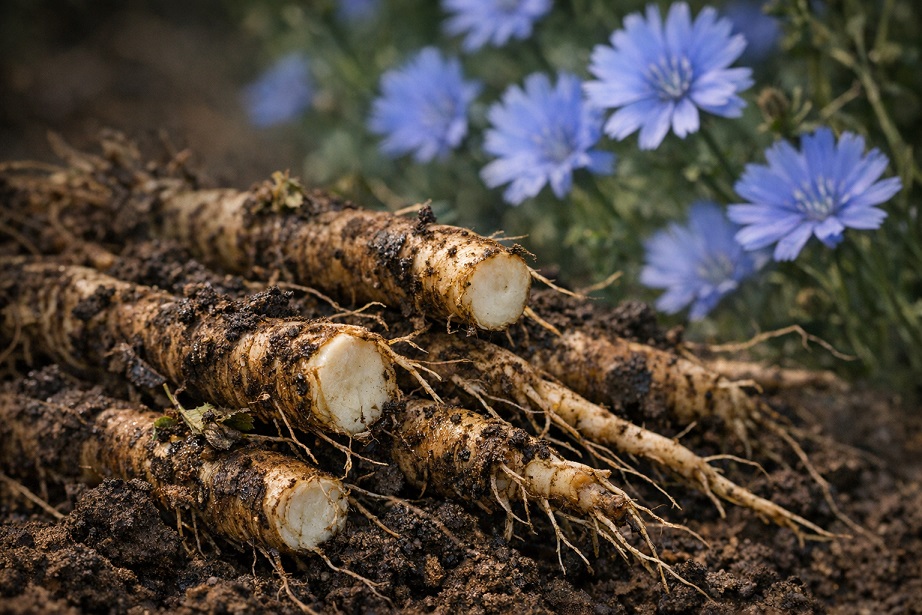
It is not the kind of plant that inspires awe on first encounter. Chicory grows along roadsides, in meadows, and in disturbed soils across Europe, Asia, and much of North America, producing bright blue flowers in summer and a tough, deep taproot that has been pulled from the earth for culinary and medicinal purposes for at least four thousand years. Ancient Egyptians cultivated it. Roman naturalists wrote about it. European settlers brought it to the Americas, where it promptly escaped cultivation and made itself at home in the wild. For most of its long relationship with humans, chicory was valued as a coffee substitute, a salad green, and a traditional digestive remedy.
What those early users could not have known is that the taproot of this unassuming plant contains one of the most scientifically significant dietary fibers ever identified: a combination of inulin and fructooligosaccharides that functions as a precision fuel source for the beneficial bacteria living in the human colon. The humble chicory root has, through centuries of empirical observation and decades of rigorous research, turned out to be the world’s most important commercial source of prebiotic fiber. That is not a trivial distinction, and the story of how it got there is worth understanding.
The Chemistry Within the Root
A fresh chicory root is composed of roughly 41 to 47 percent dry matter, of which approximately 35 to 48 percent is inulin and another 10 to 15 percent is fructooligosaccharides (FOS). These are not incidental compounds. They are the primary carbohydrate storage molecules the plant uses to fuel growth and survive winter, accumulated in the root through the growing season and drawn upon when conditions are right for renewed growth in spring. The plant stores these fibers instead of starch, which makes the root’s carbohydrate profile entirely unlike what you would find in a potato or a grain.
Inulin and FOS: Partners in the Root
Both inulin and FOS are fructan fibers, meaning they consist of fructose molecules linked together in chains. Inulin is the longer-chain form, with chains of ten to sixty fructose units, while FOS consists of shorter chains of two to eight units. This structural difference gives each fiber a distinct behavior in the human digestive tract. Inulin’s longer chains are more resistant to fermentation in the proximal colon and travel further into the digestive system before being utilized by bacteria. FOS’s shorter chains ferment more quickly and more proximally. Together they provide prebiotic activity across the full length of the colon rather than in just one region.
Neither fiber can be broken down by human digestive enzymes, which lack the specific beta-fructosidase linkages needed to cleave the fructose bonds in fructans. This indigestibility is the foundation of their prebiotic function: both fibers arrive in the colon intact and available for fermentation by the bacteria that inhabit it, selectively feeding Bifidobacterium strains with remarkable specificity.

From Field to Supplement: How Chicory Root Becomes Prebiotic Fiber
The commercial production of inulin and FOS from chicory root is a well-established industrial process that begins with freshly harvested roots being washed, sliced, and subjected to hot water extraction, which draws the inulin and FOS into solution. The resulting liquid is then purified through processes that remove proteins, minerals, and other plant compounds, leaving a highly concentrated fructan solution that is spray-dried into a fine white powder. The resulting product is essentially pure prebiotic fiber with a mild, slightly sweet taste.
Standardized Precision Formulations
Advanced chicory root inulin-FOS formulations go further than basic extraction, using additional processing to optimize the distribution of chain lengths within the final product. Formulations like Orafti Synergy1 are specifically engineered to contain a defined and reproducible ratio of inulin to FOS, with controlled chain length profiles that maximize bifidogenic selectivity and colonic coverage. This level of standardization is what allows these formulations to be used in clinical research with confidence that the results are reproducible, and it is what distinguishes a research-grade prebiotic ingredient from generic fiber supplements that happen to contain some inulin.
The standardization also matters for tolerability. The chain length distribution of an inulin-FOS product influences how rapidly it ferments in the gut and therefore how much gas is produced during that fermentation. Products with a higher proportion of very short chains ferment quickly and can cause bloating in sensitive individuals. Products with a better balance of short and longer chains ferment more gradually, providing the bifidogenic effect with considerably less digestive disruption.
A History of Digestive Use That Preceded the Science
Long before the concept of prebiotics existed, chicory root was being used as a digestive remedy. Ancient Roman physicians described it as beneficial for the liver and the gut. Medieval European herbalists recommended chicory for digestive complaints. The traditional use of chicory as a coffee substitute, particularly in France and the American South, was partly driven by the observation that chicory-containing coffee was less likely to cause the digestive discomfort associated with pure coffee, a benefit almost certainly related to the prebiotic fiber content of the chicory root used in the blend.
This long history of digestive use is not coincidental. It reflects centuries of empirical observation that something in the chicory root was beneficial for gut function, even though the mechanism, selective Bifidobacterium stimulation through fructan fiber fermentation, was not identified until the modern era of microbiome research. The traditional use and the modern science point in the same direction, which is the kind of convergence that tends to be meaningful.
Why Chicory Root Remains the Standard
Several other plants contain inulin and FOS, including Jerusalem artichoke, garlic, onion, leek, asparagus, and dandelion root. None has supplanted chicory root as the primary commercial source of prebiotic fiber, and the reasons are practical as well as nutritional. Chicory root can be cultivated at agricultural scale with high yields of inulin per hectare. The extraction and purification process is efficient and produces a consistent, clean product. The research base built on chicory root inulin-FOS is so extensive that it provides a level of evidence simply not available for any other source.
There is also the matter of sustainability. Chicory is a robust, drought-tolerant crop that requires relatively modest inputs compared to many other commercial crops. It grows well in temperate climates across Europe, where most commercial production occurs, and the extraction process uses water as its primary solvent, leaving minimal chemical residue. For a product that is consumed daily as part of a long-term health strategy, the combination of nutritional efficacy, production consistency, research depth, and environmental profile makes chicory root inulin-FOS the responsible as well as the effective choice.
The road from roadside weed to research-backed gut health ingredient is a long and interesting one, and chicory root has traveled it more convincingly than any other plant in this category. The blue flowers nodding in the summer breeze are rather more consequential than they appear.