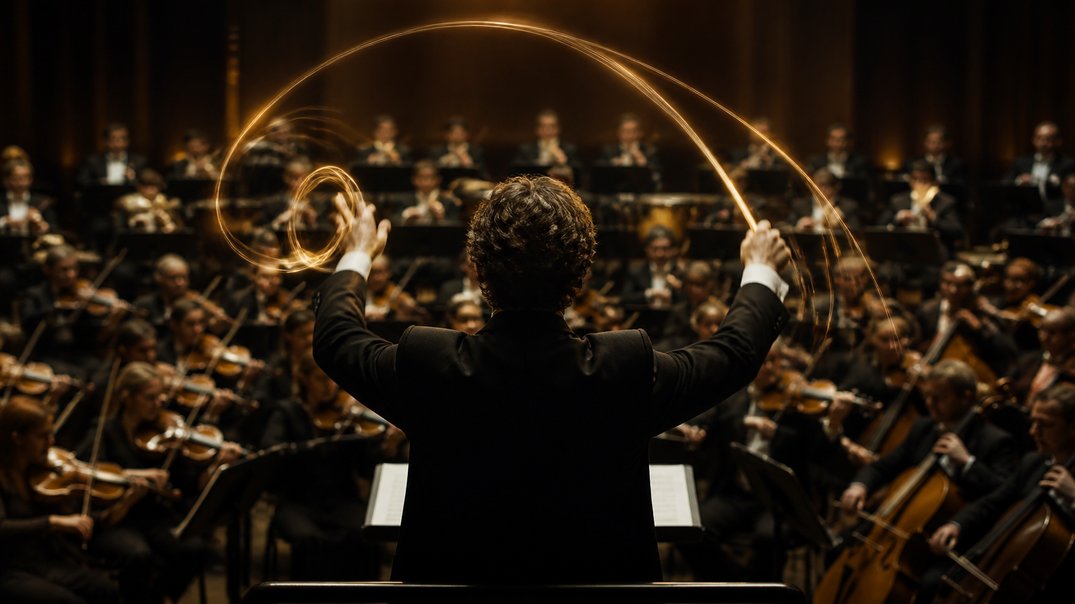
Musical conductors track dozens of inputs at once largely through years of training that sharpens their hearing across the whole space around them. A well-known study found that conductors could locate sounds coming from the sides far better than pianists or non-musicians. Their brains use the same basic hardware as everyone else, but practice reshapes where their attention goes.
Conductors Hear Sound From the Sides
Standing in front of an orchestra, a conductor faces strings, brass, woodwinds, and percussion arranged in a wide arc. To do the job well, they need to know who is playing what, and where, in real time.
In a 2001 Nature paper titled Superior Auditory Spatial Tuning in Conductors, Thomas Münte and colleagues used brain-potential recordings to study professional conductors. They reported enhanced auditory localization mechanisms in peripheral space, meaning conductors seemed especially good at pinpointing sounds off to the side.

A Simple Test With Striking Results
A Scientific American summary describes the setup. Researchers tested 7 conductors, 7 pianists, and 7 non-musicians. Three loudspeakers sat in front of each person and three to the sides. Standard sounds played in random order with occasional odd ones mixed in, and participants pressed a button when an odd sound came from a chosen speaker.
All three groups did equally well when the odd sound came from the center. Only the conductors could reliably find odd sounds from the side speakers. The groups were small, so more research would help, but the contrast was clear.
Same Brain Hardware, Different Training
Did conductors grow special neurons? Apparently not. The same brain areas were active in all three groups, so the difference seems to come from how conductors use their brains rather than from a unique design.
The researchers suggested that conductors, who stand surrounded by an orchestra arranged in a semicircle, must direct their listening to the sides, and constant training seems to strengthen that skill. Non-musicians usually turn their heads toward interesting sounds, which makes sounds in front easier to separate. Conductors learn to listen wide without moving much.

Zooming In and Out Between One Player and the Whole Sound
The abstract of the Nature paper notes a second challenge: picking out one musician within a section while also taking in the entire orchestral sound. Think of it as a zoom lens that moves between a single violin and the full wall of music.
It is worth being clear about what this research does and does not show. The study tested spatial hearing, which is one slice of a conductor’s job. It does not prove that conductors can truly do dozens of things at the same moment. A more modest reading is that practice makes certain kinds of attention fast, wide, and flexible.
Try Conductor-Style Listening at Home
You can train a slice of this skill with a few simple exercises:
- Layer your listening. Play an ensemble recording and follow one instrument for a minute, then listen to the whole sound.
- Locate sounds in a room. Close your eyes and point toward noises you hear to your left and right.
- Sit to the side at a concert. Notice how different sections sound from an unusual spot.
- Listen without turning your head. Practice staying still while you track sounds around you.
Appreciate the Orchestra Behind the Baton
Conductors show how far trained attention can stretch. Their skill is a product of repetition, curiosity, and an ear tuned to the full circle of sound. Next time you watch an orchestra, enjoy the idea that one person is quietly mapping dozens of voices at once.
Frequently Asked Questions About Conductors and Attention
Do conductors have special brains?
Research suggests the same brain areas are used by conductors and non-conductors. Training appears to change how conductors direct their attention.
Can conductors really listen to everyone at once?
The study showed unusually good hearing for sounds from the sides, not true multitasking. Practice makes their attention wide and flexible.
Can I train my ears like a conductor?
You can practice similar skills, such as following one instrument and then the whole sound. How far the improvement goes will vary from person to person.