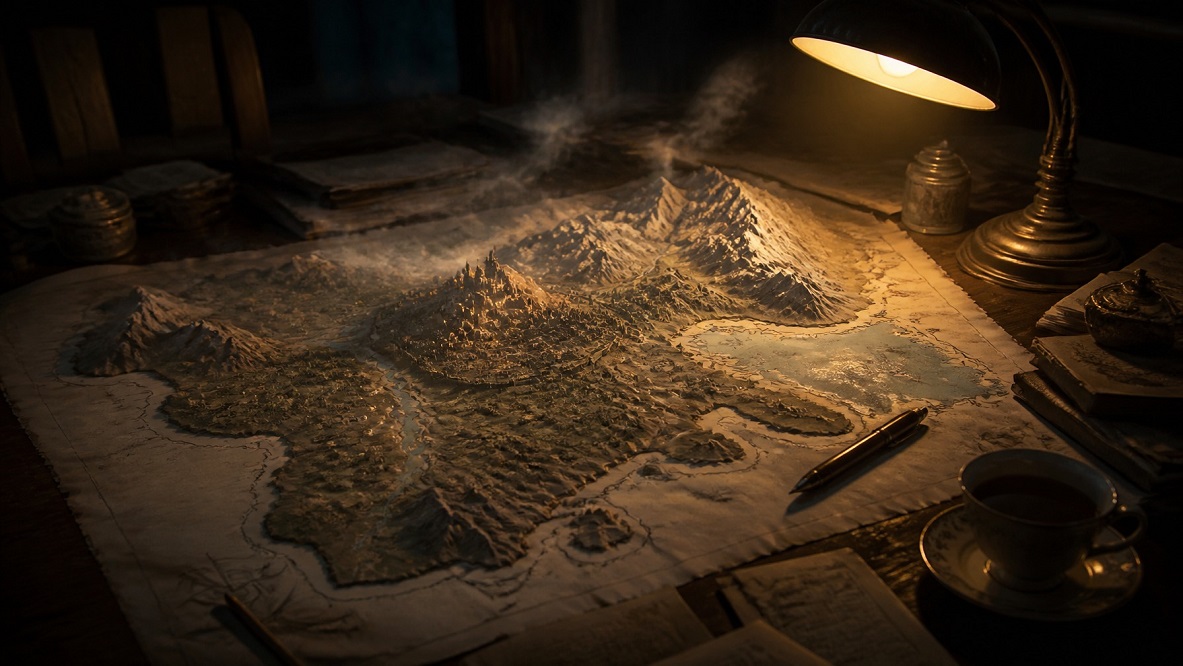
Building a fantasy world is a workout for your brain because it asks you to generate new ideas, keep a large web of facts consistent, and imagine how other minds would think and behave, all at once. No study has measured worldbuilding directly, but the mental skills involved are well understood. It is a plausible, enjoyable way to exercise creativity, memory, and reasoning together.
Many Mental Muscles at Once
Most hobbies lean on one or two skills. Worldbuilding recruits a whole team. You invent, which is creativity. You remember what you invented, which is memory. You check new ideas against old ones, which is logic. And you picture how people in your world would feel and act, which is perspective-taking.
That mix is rare. A crossword exercises vocabulary, and a sudoku grid exercises logic, but a continent with trade routes and rival kingdoms asks for all of it, on your own schedule and with no wrong answers.
Consistency Is the Hard Part
Coming up with a dragon is easy. Deciding what the dragon eats, where it sleeps, how villagers cope, and why the kingdom’s economy depends on it is hard. Every answer constrains the next one. If the desert city has no rivers, where does its water come from?
Working through those constraints is a form of reasoning under limits. You hold several facts in mind, notice a conflict, and resolve it. Psychologists call the mental workspace that does this working memory, and it is a skill that grows with use. It’s reasonable to expect that sustained worldbuilding gives it regular practice, though that is an inference, not a measured result.
Thinking Like a Culture
The most absorbing part of building a world is imagining its people. What do they fear? What do they celebrate? What counts as an insult? To answer, you step out of your own assumptions and reason from a different starting point.
This is the same ability we use to understand real people, often called theory of mind. Building a culture that behaves differently from yours, but still coherently, stretches it in a safe setting. It also reveals how many of your own habits are choices, not laws of nature.

Why Worldbuilders Never Run Out of Material
Real-world knowledge feeds invented worlds. Climate shapes farming, geography shapes borders, and language shapes names. Worldbuilders often find themselves reading about plate tectonics, medieval trade, or linguistics to make an invented place feel right.
That pulls a hobby of imagination toward learning. A map that needs believable rainfall sends you to read about wind patterns. A culture that needs a believable religion sends you to read about real ones. The curiosity tends to compound.
Start Small and Build Outward
You do not need a thousand-page atlas. A few practical steps will start the process:
- Sketch one valley, and decide where the water, food, and danger are.
- Invent one custom, such as a greeting, and write down why it exists.
- Give your world one scarce resource, and trace who fights over it.
- Keep a short notes file so future ideas can be checked against past ones.
- Revisit your world weekly and look for contradictions to fix.
The notes file matters more than it seems. It acts as external memory, freeing your attention for new ideas, and fixing contradictions later is a satisfying puzzle in its own right.
Creative Effort, Focus, and Where Nootropics Fit
Sustained creative work takes focus, rest, and curiosity. Curious readers sometimes ask about nootropics, supplements marketed for focus and memory. Evidence varies widely by ingredient, and no capsule replaces regular practice or sleep.
Frequently Asked Questions
Is Worldbuilding Good for the Brain?
It plausibly exercises creativity, working memory, logic, and perspective-taking together, although this article does not cite a study that measured worldbuilding directly.
Do I Need Writing Skill to Build a World?
No. Maps, notes, and lists of customs are enough. The mental work happens in inventing and checking ideas, not in polished prose.
How Do I Keep a Fantasy World Consistent?
Keep a short notes file of the facts you have invented, and check each new idea against it. Contradictions you catch become useful puzzles to solve.