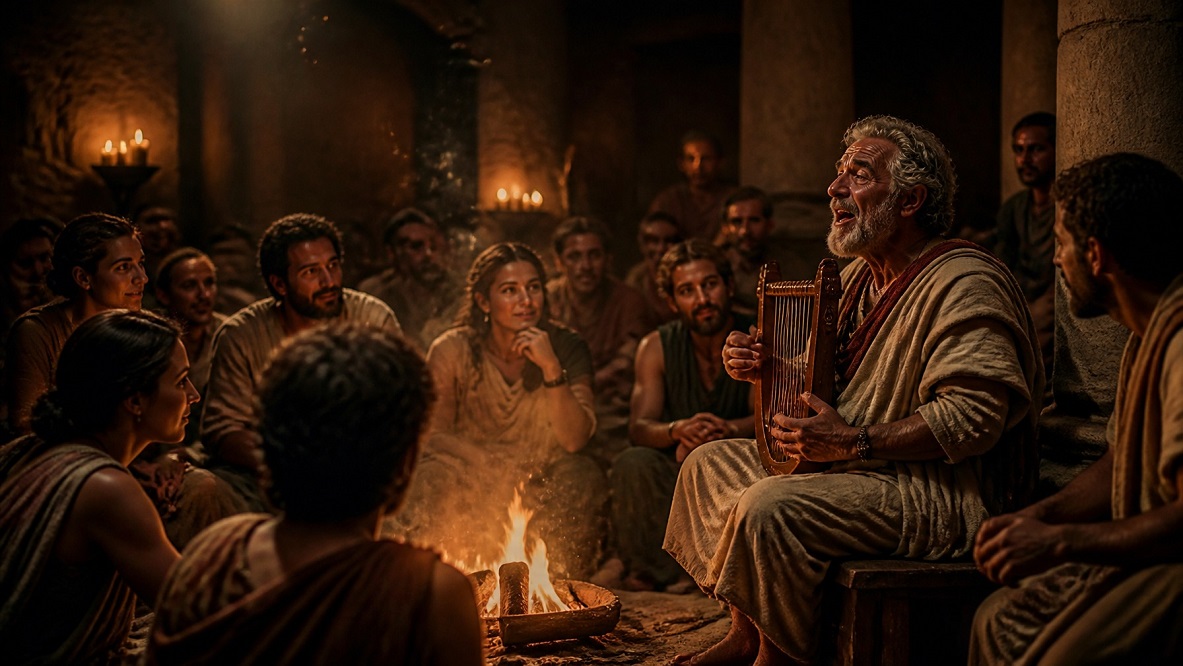
Ancient bards memorized epic poems not by learning every line word for word, but by composing within a toolkit of formulas, rhythm, and story structure that the brain finds easy to store. Scholars have argued this since Milman Parry’s work on Homer, and modern memory science helps explain why it works: rhythm, imagery, and narrative give memory something to hold. The result is less like rote learning and more like fluent improvisation.
Not Memorizing, Composing
In the early twentieth century, Milman Parry noticed that Homer’s epics repeat stock phrases such as swift-footed Achilles, rosy-fingered Dawn, and the wine-dark sea. He defined a formula as a group of words regularly used under the same metrical conditions to express a given idea, a definition discussed in John D. Smith’s study of oral epic diction.
Albert Lord extended the idea in The Singer of Tales (1960), drawing on his study of living oral singers in what was then Yugoslavia. A singer, he argued, did not recite a fixed text. He rebuilt the poem in performance from a stock of phrases, scenes, and plot patterns. Each performance was a new composition built from familiar parts.
Rhythm as a Memory Scaffold
Meter works like a mold. If a line must fit a set rhythm, the number of words that will fit shrinks dramatically, and the right one often feels almost inevitable. A bard who lost a word could reach for a formula that fit the same slot.
Music and chant likely helped as well. Most people can recall song lyrics they have not seen in years, and it is reasonable to expect that rhythm and melody gave ancient performers the same kind of support.
Story Structure as a Map
Epics also repeat larger building blocks. Scholars of Homer describe type-scenes, recurring sequences such as arming for battle, preparing a feast, or setting out on a voyage. A bard who knew the type-scene could fill in its beats without searching for them.
Cause and effect did the rest. When each event naturally leads to the next, remembering one scene cues the next. A bard could lengthen or shorten a tale to fit the audience, because he was following a route, not reading a script.

Places as Prompts
Some traditions tie stories to the landscape itself. Aboriginal Australian songlines link songs and stories to routes and landmarks, so walking the land recalls the narrative. Researcher Lynne Kelly has argued in The Memory Code that many oral cultures used place-based techniques like these, related to the memory palace of classical rhetoric.
The method of loci, imagining items placed along a familiar route, appears in both settings. If the argument holds, an epic was partly a journey stored in space.
What the Brain Is Doing
Memory researchers describe recall as reconstruction, not playback. We rebuild a memory each time using cues, and details can shift between tellings. Oral performance may have embraced that fact. A bard’s brain was rebuilding the poem from rhythm, formulas, scenes, and places, which made the poem both stable at its core and flexible at its edges.
Try Memorizing Like a Bard
You can test the method on a short poem or speech:
- Read the passage aloud and find its rhythm.
- Mark any repeated phrases or patterns.
- Break it into scenes, and picture each one in a different room of a familiar place.
- Perform it aloud without looking, improvising where you stumble.
Memory, Practice, and Where Nootropics Fit
Bards trained for years, and their skill came from practice. Curious readers sometimes ask about nootropics, supplements marketed for focus and memory. Evidence varies widely by ingredient, and no capsule replaces rehearsal.
Frequently Asked Questions
Did Bards Memorize Every Word?
Probably not in the modern sense. Parry and Lord argued that singers recomposed the poem each time from formulas, scenes, and plot patterns.
Who Was Milman Parry?
He was a scholar who proposed that Homeric poetry was composed through formulas, phrases fitted to the meter. Albert Lord continued his work with living oral singers.
Do These Techniques Work Today?
Rhythm, imagery, structure, and place cues plausibly help modern learners too. The exercise above is an easy way to test them yourself.