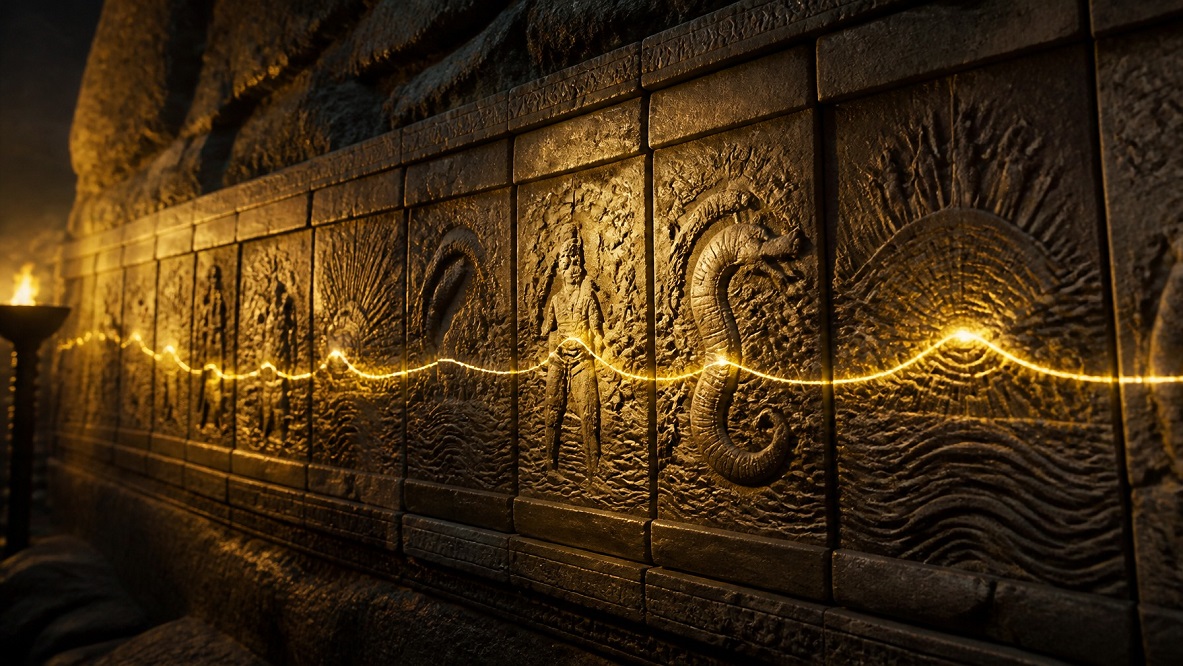
Ancient myths share the same story patterns because of four overlapping forces: common human experiences, shared mental habits, stories that travel and mutate, and plots that survive because they are memorable. No single idea explains every parallel, and the best answer is probably a blend. Together, they suggest that myths are less like isolated inventions and more like well-tested tools for the human mind.
The Patterns Worth Explaining
Start with the evidence that puzzles people. Great floods wipe out the world and a chosen few survive. Heroes leave home, face trials, descend into a dark place, and return changed. Tricksters break rules and accidentally build civilization. Figures die and return with the seasons. These shapes appear in cultures that, as far as we know, never met.
Mythologist Joseph Campbell argued in The Hero with a Thousand Faces that many hero stories follow a single underlying journey. Writer Christopher Booker later proposed seven basic plots. Scholars debate how universal such patterns really are, and critics point out that selective reading can make any two stories look alike.

The simplest explanation is that humans share a life. Everyone is born, grows up, leaves home, fears death, and depends on the seasons. Many early societies also lived beside rivers that flooded and skies that kept strict calendars. Stories about those facts would naturally echo one another.
On this view, the hero’s journey is a story about growing up, and the flood myth is a story about the fragility of a world you depend on.
Psychologist Carl Jung proposed a stronger version. He suggested that humans inherit universal patterns, which he called archetypes, such as the hero, the shadow, and the wise elder, and that myths express them. Many modern scholars consider the idea hard to test, but a gentler version survives.
Human brains share habits: close attention to other minds, sensitivity to danger, concern for fairness, and interest in kinship. A story that presses those buttons will feel gripping to almost anyone. It’s reasonable to see myths as outputs of the same mental machinery, even without inherited symbols.

Idea Three: Stories Travel and Mutate
Some similarities may come from a shared ancestry. In a 2016 study reported by Science News, Jamie Tehrani and Sara Graça da Silva analyzed 275 magic tales drawn from a database of more than 2,000 folktale types. They treated the stories like genetic data, comparing them with Indo-European language family trees.
Four tales were strongly associated with the structure of Proto-Indo-European, a language from about 6,000 years ago. Only The Smith and the Devil passed the strictest statistical test, suggesting a Bronze Age origin. Early versions of Rumpelstiltskin and Beauty and the Beast appeared to date back 3,000 to 4,000 years. One critic noted that Proto-Indo-European may not have had a word for smith, which casts doubt on the dating.
Idea Four: Memorable Plots Survive
Before writing, a story had to be remembered to exist. Plots with clear heroes, villains, repeated trials, and dramatic reversals are easier to retell accurately. Over generations, forgettable stories vanished, and sticky ones remained. This is an inference, but it offers a tidy twist: myths may share patterns because those are the patterns human memory keeps.
A Thought Exercise: Test the Patterns Yourself
Try this:
- Pick a myth from a culture you know little about and list its main beats.
- Match those beats to a story you know well, such as a favorite film.
- Ask which of the four ideas best explains the match.
- Notice where the pattern breaks, since differences can be as revealing as similarities.
Stories, Memory, and Where Nootropics Fit
Stories work as memory aids, and exercises like the one above give your recall and attention a workout. Curious readers sometimes ask about nootropics, supplements marketed for focus and memory. Evidence varies widely by ingredient, and no capsule replaces curiosity or sleep.
Frequently Asked Questions
Are All Myths Really the Same?
No. Overlaps are real, but scholars debate how universal they are, and the differences between cultures are often as meaningful as the similarities.
Did Myths Spread From a Single Source?
Some tales may be thousands of years old and may have traveled alongside languages. Others probably arose independently because people face similar situations.
What Is the Hero’s Journey?
It is Joseph Campbell’s proposed pattern in which a hero leaves home, faces trials, and returns transformed. It is a useful lens, though not every story fits it.