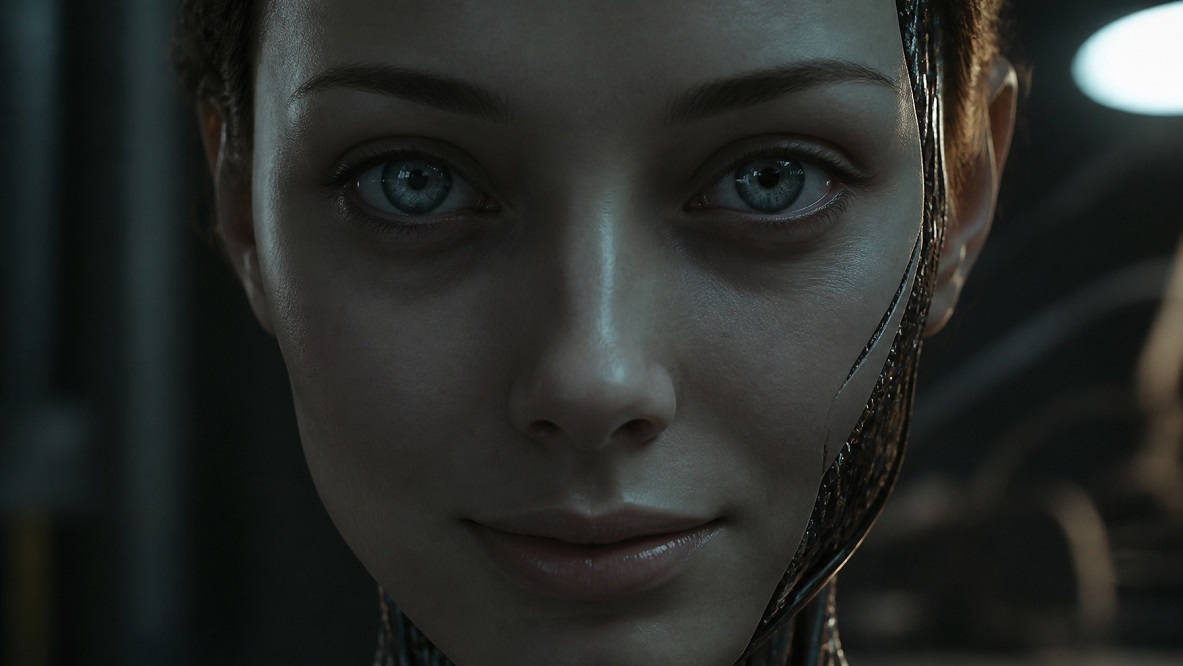
The uncanny valley makes almost-human faces feel wrong because the closer something gets to looking human, the more sharply the brain notices what is off. A cartoon robot feels charming. A near-perfect android with slightly dead eyes feels unsettling. Scientists have several competing explanations, and none has been settled, but each tells us something about how finely tuned we are to faces.
What Mori Proposed
According to Britannica, Japanese roboticist Masahiro Mori proposed the uncanny valley in a 1970 essay. He argued that people’s liking for an object grows as it becomes more humanlike, until it becomes nearly perfect. At that point the feeling turns into unease, and liking rises again only when the object is truly human. Mori also thought movement intensified the effect.
Plot that on a graph, and you get a dip in the curve, the valley. It began as a design warning for robot makers and has since spread to animation, video games, and digital avatars.

Why Faces Are Special
Humans are exquisitely sensitive to faces. We read identity, emotion, health, and attention from tiny cues: the timing of a blink, the wrinkle around an eye, the glint of moisture. A mostly right face with a few wrong cues puts us in the odd position of recognizing a face while sensing something false about it.
That contrast may be the heart of the matter. A clearly artificial face makes no promise of being human, so nothing breaks. A nearly human face makes a promise and then fails to keep it.
Three Leading Explanations
Britannica lists several proposed explanations:
- Perceived consciousness: Near-human robots may trigger the unsettling thought that they can think and feel.
- Instinct: Evolution may lead people to read unnatural movement as a sign of illness or danger.
- Ambiguity: Being unsure whether something is human or not may itself be what disturbs people.
Researchers have proposed others, including that mismatched features, such as a realistic face with unrealistic skin, cause a prediction error that feels like discomfort. It is likely that more than one factor operates, and the strength of the effect varies from person to person.

Is the Valley Even Real?
Mori’s idea began as an intuition, and researchers have debated whether it forms a single smooth dip or a collection of separate effects. Experiments have reported mixed results, depending on the images, the people, and the measures used.
Still, the experience is familiar enough that many animators and game designers deliberately avoid near-realism, choosing stylized characters instead. It’s reasonable to take the valley as a useful rule of thumb, not a precise law.
What It Says About Your Brain
The uncanny valley works as a diagnostic. It shows that your brain is not just recognizing faces but constantly checking them against a detailed expectation. When the check fails, you get a vague alarm, even if you cannot say what is wrong.
That is a useful clue about how perception works generally. We do not see raw pictures. We see pictures judged against predictions, and mismatches get noticed.
Notice It in the Wild
Try a small experiment the next time you watch a film with digital characters or a video of a humanoid robot:
- Pause on a face and ask exactly what feels off.
- Look at the eyes, the mouth corners, and the timing of movement.
- Compare with a stylized cartoon version and notice whether the unease disappears.
Naming the specific cue is a good attention exercise, and you may find that the same detail bothers other people too.
Faces, Attention, and Where Nootropics Fit
Spotting subtle mismatches rewards sharp, patient attention. Curious readers sometimes ask about nootropics, supplements marketed for focus and memory. Evidence varies widely by ingredient, and no capsule replaces rest or practice.
Frequently Asked Questions
What Is the Uncanny Valley?
It is the idea, proposed by Masahiro Mori in 1970, that liking for an object rises as it becomes more humanlike until it is nearly perfect, at which point unease sets in.
Why Do Almost-Human Faces Feel Creepy?
Proposed explanations include perceived consciousness, instinctive reactions to unnatural movement, and ambiguity about whether something is human. None is settled.
Is the Uncanny Valley Proven?
Not conclusively. Experiments have reported mixed results, so it is best treated as a useful rule of thumb.