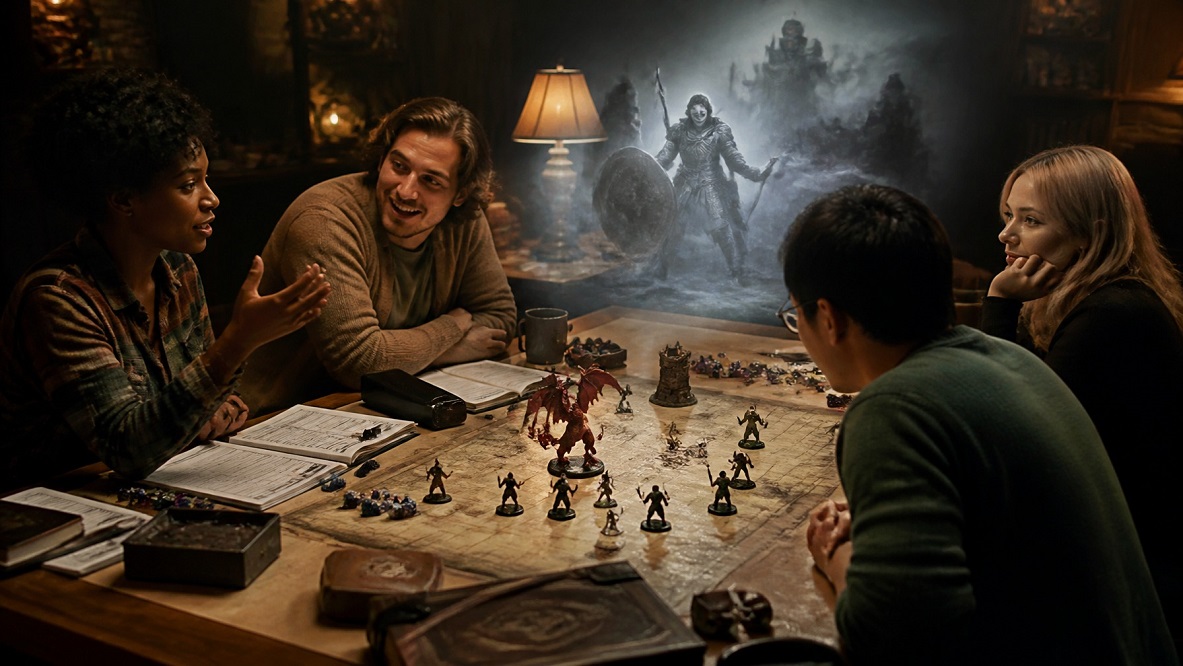
Tabletop role-playing games plausibly train social cognition and planning because every session asks players to imagine other minds, negotiate with real people, and pursue goals under uncertainty. The evidence for lasting benefits is still limited, so this article treats the idea as a well-grounded thought exercise: the activity uses these skills heavily, and practice usually helps.
A Conversation With Rules
In a typical game, a group sits around a table while a game master describes a situation and players say what their characters do. A die adds chance. The rest is talk, imagination, and decisions.
That structure is unusual. It combines the freedom of improvised storytelling with the constraints of a rules system, and the group shares one imagined scene that exists only in everyone’s heads. Keeping that shared picture aligned is a social achievement in itself. If one player imagines a narrow tunnel and another imagines a vast cavern, the group has to notice, ask questions, and settle on one version. Every session quietly rehearses that kind of clarification.
Thinking in Other Minds
Playing a character means reasoning from a perspective that is not yours. What does a cautious cleric want? How would a suspicious guard react to a stranger? You must answer in character, which is a form of perspective-taking.
Players also model each other. Will the rogue cooperate with the plan or act alone? Will the game master’s villain bluff? Researchers call the ability to reason about others’ beliefs and intentions theory of mind. It’s reasonable to expect that a hobby built around it gives regular practice, although this article does not cite a study showing a measured improvement.
Planning as a Team Sport
Games set problems that cannot be solved alone. A party must cross a hostile region, rescue a hostage, or negotiate a truce. Players split roles, estimate risks, and sequence actions. When plans fail, they adapt.
These are the skills psychologists group as executive function: setting goals, holding a plan in working memory, shifting strategy, and resisting impulses. The table adds a social layer. A good plan is one everyone agrees to, so persuasion and compromise become part of planning. Quiet players learn to speak up, and enthusiastic players learn to listen, because a plan that ignores half the group usually falls apart.

Low Stakes, High Rehearsal
The fictional setting matters. Failing in a game costs a character, not a career. That safety lets players try bold ideas, lie convincingly, mediate arguments, or take leadership roles they might avoid elsewhere.
Educators and therapists have experimented with role-playing for this reason, and some published work explores empathy and values through role-play. The research quality varies, and results from classroom or clinical settings do not necessarily apply to a casual game night. Still, the logic of rehearsal in a safe space is easy to see.
Get More From Your Table
Whether you play often or are considering your first session, a few habits can sharpen the benefits:
- Before acting, say what your character wants and why.
- Guess what each other player will do next, then compare.
- Make a plan together, then name the biggest risk.
- After the session, discuss which decision mattered most.
- Rotate roles, including the game master, to practice different skills.
The game master seat is especially demanding. It requires improvising for every character, tracking rules, and reading the mood of the table, all in real time.
Teamwork, Attention, and Where Nootropics Fit
A long session asks for sustained attention and memory for names, places, and plans. Curious readers sometimes ask about nootropics, supplements marketed for focus and memory. Evidence varies widely by ingredient, and no capsule replaces good notes, practice, or sleep.
Frequently Asked Questions
Do Role-Playing Games Improve Social Skills?
They give frequent practice in perspective-taking, negotiation, and teamwork. This article does not cite proof of lasting improvement, so treat the benefit as plausible, not guaranteed.
What Planning Skills Do These Games Use?
Players set goals, weigh risks, hold plans in working memory, and adapt when plans fail, skills often grouped as executive function.
Do I Need Experience to Start?
No. Many groups welcome beginners, and a simple adventure with a patient game master is enough to start practicing.