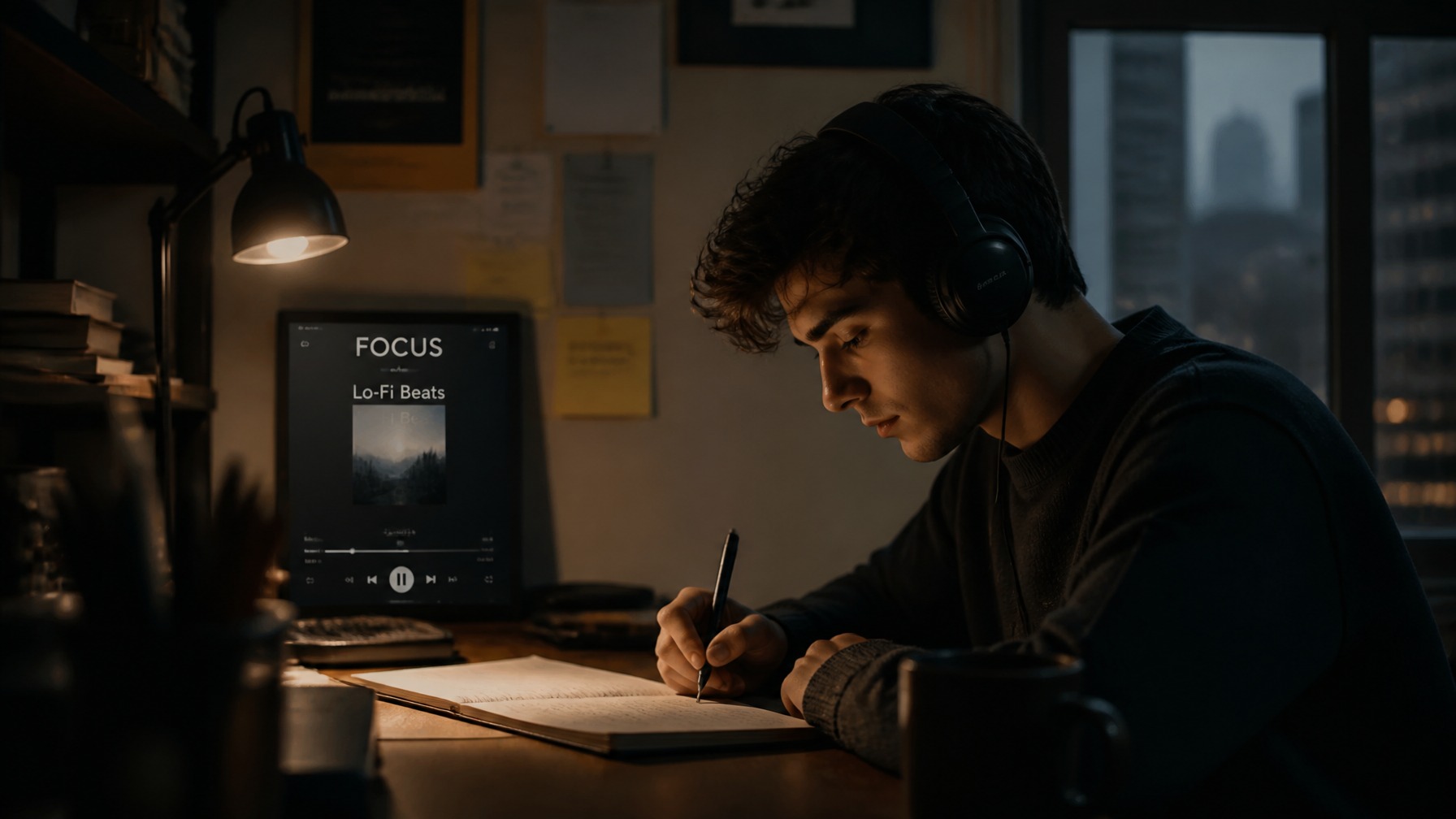
Short answer: It depends on the task and the music. Background music tends to help with simple, repetitive, or low-demanding activities, and instrumental music you enjoy can reduce mind-wandering during tedious work. But music with lyrics reliably hurts performance on tasks that involve reading, writing, or other language processing, because both draw on the same mental machinery.
Why the Research Doesn’t Give One Clean Answer
Studies on music and concentration have produced genuinely mixed results for decades, and that inconsistency isn’t a flaw in the research so much as a reflection of how many variables are at play: the type of task, the genre and tempo of the music, whether it has lyrics, and how much the individual listener actually likes what’s playing. A review published in Psychological Research noted that findings on background music and sustained attention have been contradictory for decades, with some studies favoring music and others favoring silence. One useful way researchers make sense of this is the idea of an inverted-U relationship between arousal and performance. Music tends to raise arousal, and a boost in arousal helps when the task itself is boring or under-stimulating, but the same boost can push a person past their optimal level and hurt performance on a task that’s already demanding. That’s part of why background music seems to help more with monotonous, low-effort activities than with complex problem-solving.
Lyrics Are the Biggest Dividing Line
Across the research, one of the more consistent findings involves lyrics specifically. A randomized controlled trial published in the journal Work found that background music with lyrics had significant negative effects on concentration and attention, and the authors concluded that instrumental music is the safer choice in environments where focus matters.
The likely explanation is a conflict between two systems that both rely on language. Reading, writing, and other verbal tasks draw on the brain’s language-processing resources, and lyrics compete directly for those same resources in a way that a wordless melody doesn’t. This is sometimes discussed alongside the well-documented “irrelevant speech effect,” in which any background speech, sung or spoken, interferes more with verbal working memory than non-speech sound does. For math problems, visual-spatial tasks, or repetitive manual work that doesn’t lean as heavily on verbal processing, this particular conflict matters less.
Personal Preference and Familiarity Matter More Than Genre
It’s tempting to look for a single “best” genre for focus, and classical or instrumental music is commonly recommended. But the research suggests personal fit outweighs genre. One study on workplace concentration found that background music’s effect on attention had more to do with how much the listener liked the music than with what type it was; both strongly disliked and, in some cases, strongly liked music could pull focus away from the task at hand, while more neutral or moderately preferred music tended to interfere less. A separate laboratory study on sustained attention found that music participants had chosen themselves increased “task-focus” states by reducing mind-wandering, without measurably increasing distraction from external sources. A Harvard-trained neuroscientist who studies music and the brain has similarly argued, in comments to CNBC, that familiar, well-liked music can support focus in part by lowering stress, and that there isn’t a single genre that works best for everyone.
How to Use Background Music Strategically
- Save instrumental tracks for reading and writing. Since lyrics compete with language processing, wordless music, ambient sound, or classical pieces are the safer bet for anything text-heavy.
- Match the music’s intensity to the task’s difficulty. Save higher-energy, more arousing music for repetitive or tedious tasks, and dial it back for anything cognitively demanding.
- Pick something moderately liked, not a favorite you’ll want to sing along to. Songs you love enough to actively engage with can become their own distraction.
- Test silence too. If a task is genuinely complex, don’t assume music is helping just because it feels more pleasant than quiet.
There’s no universal rule here, and that’s a fair reflection of the evidence itself. The most useful approach is to treat background music as a tool to experiment with, matching it to the kind of thinking a given task actually requires.