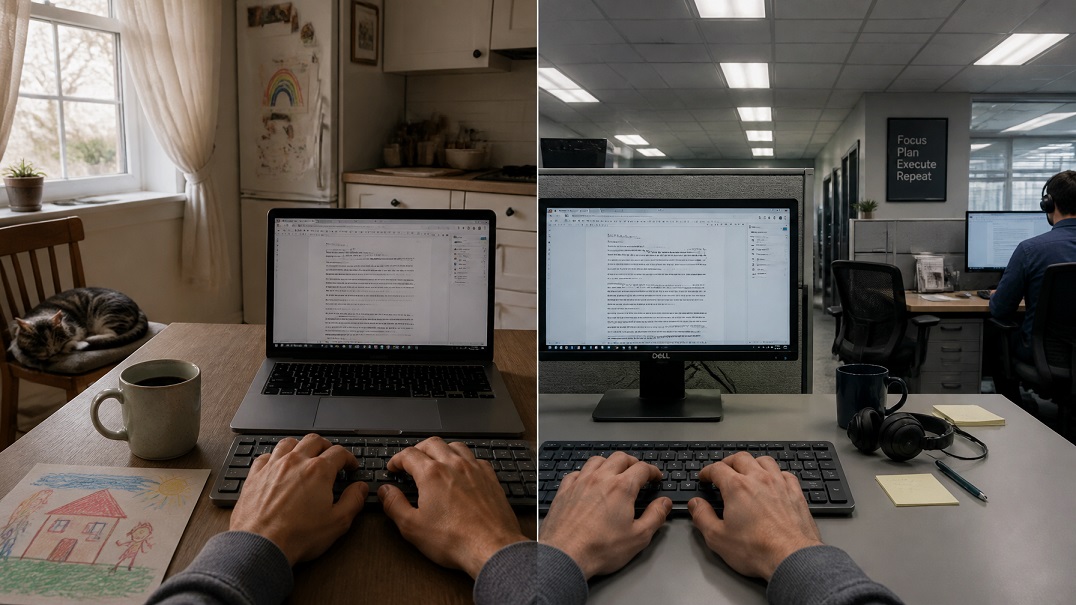
The debate over remote work has been conducted primarily in the language of productivity metrics, real estate costs, and management philosophy. Companies have issued return-to-office mandates citing collaboration and culture. Employees have cited focus, autonomy, and the hours reclaimed from commuting. Both sides have invoked research selectively. The result is a public conversation that generates more heat than light — which is unfortunate, because the neuroscientific and cognitive psychological literature on how different working environments affect the brain is considerably more nuanced, and more useful, than most of the debate has acknowledged.
The central finding of that literature is not that one environment is categorically superior to the other. It is that the home and the office create fundamentally different neurological conditions — different states of arousal, different attentional contexts, different hormonal environments, different social processing demands — and that the cognitive consequences of those differences are specific to the type of work being done, the individual’s neurological makeup, and the quality of each environment as actually configured rather than as ideally imagined. A good home office and a good traditional office both outperform their poor counterparts. The question worth asking is not which is better in the abstract but which conditions each environment creates, for which kinds of work, and at what cost.
Context and the Brain: How Place Shapes Cognition
One of the most robust findings in cognitive psychology is that learning and memory are context-dependent: information encoded in a particular environment is recalled more easily when the brain is back in that environment, because the contextual cues of the space — its sensory characteristics, its associated memories and habits — are encoded alongside the information itself as part of the memory trace. This is the principle of context-dependent memory, documented extensively since the foundational work of Godden and Baddeley in the 1970s, who famously demonstrated that divers who learned word lists underwater recalled them better underwater than on land, and vice versa.
The Work Mode Problem at Home
The home environment presents a specific challenge to context-dependent cognition: it is a space whose dominant associative context, for most people, is rest, leisure, and personal life rather than work. The neural associations that any given space accumulates through repeated experience are not merely metadata; they actively prime the cognitive and motivational states associated with that context when the person enters the space. Walking into a kitchen primes hunger and food-related cognition. Walking into a gym primes physical effort and motivational arousal. Walking into an office, for someone who has worked in offices for years, primes a cognitive set associated with professional work, task engagement, and the social context of professional behavior.
For someone working from home, particularly from a space that serves multiple purposes — a bedroom, a living room, a kitchen table — the associative context is ambiguous or actively counterproductive. The brain is being asked to adopt a work cognitive set in an environment whose accumulated associations prime rest, informality, and disengagement from professional demands. Research on context-dependent cognition predicts, and several studies have confirmed, that this ambiguity impairs the establishment and maintenance of the mental set required for demanding cognitive work. The home worker’s brain must actively work against the contextual priming of the space rather than benefiting from it, which constitutes an ongoing cognitive cost that is easy to underestimate because it is felt as low-grade distraction and motivational friction rather than acute impairment.
Dedicated Home Workspace and the Context Solution
The practical implication of context-dependent cognition for home workers is the importance of establishing a genuinely dedicated workspace — not merely a corner of a multifunctional room, but a space used exclusively or near-exclusively for work, whose associative context can therefore become specifically work-priming over time. Workers who have access to a dedicated home office consistently show better cognitive performance and job satisfaction than those working from shared or multifunctional spaces, and the difference is not fully explained by the reduced physical interruptions and noise that a dedicated space provides. The associative conditioning of the space itself is an independent variable, and it takes time to accumulate. A newly established home office does not immediately produce the cognitive priming of a long-established one; the contextual work associations build with repeated experience of working in that space.
Arousal, Social Facilitation, and the Office Advantage
The office environment provides a set of social and environmental conditions that have specific effects on arousal and cognitive performance that the home environment typically does not replicate. Understanding these effects requires revisiting a century-old finding in social psychology that has taken on new relevance in the remote work era.
Social Facilitation and the Presence of Others
Social facilitation — the finding that the mere presence of other people increases arousal and enhances performance on well-learned or simple tasks while impairing performance on novel or complex ones — was first documented by Norman Triplett in 1898 and extensively studied throughout the 20th century. The mechanism, proposed by Robert Zajonc in 1965, involves the arousal produced by the presence of others activating the dominant response — the most practiced or habitual response available in a given situation. For well-practiced, routine tasks, the dominant response is correct, and social arousal enhances it. For novel, complex, or ambiguous tasks, the dominant response may be incorrect or incomplete, and social arousal impairs performance by strengthening the habitual response at the expense of the more effortful processing the task requires.
The office, with its ambient presence of colleagues, provides a continuous low-level social facilitation effect. For workers performing routine, well-practiced cognitive tasks — data entry, processing familiar requests, executing standard procedures — this effect is a genuine advantage: the ambient arousal of the shared workspace maintains alertness and supports efficient execution. For workers engaged in novel problem-solving, creative thinking, or the learning of complex new material, the same arousal is a disadvantage — and these are precisely the conditions under which working from home, with its lower ambient arousal, may provide a cognitive benefit.

Accountability and the Visibility Effect
Separate from social facilitation, the physical visibility of being in an office — being seen to be at one’s desk, observed by colleagues and managers, present in a space whose norms actively enforce work behavior — produces an accountability effect that influences motivation and task engagement. This is not merely a management surveillance concern; it reflects a genuine feature of how human motivational systems operate. The brain’s motivational architecture is partly social: the prospect of being observed performing work activates neural systems associated with reputation maintenance and social identity that are not activated to the same degree when working alone.
Research on the behavioral effects of observation has consistently found that people perform tasks with greater persistence and effort when they believe they are being observed, even by an observer with no evaluative role. For work that depends on sustained motivational engagement — the willingness to persist on a demanding task in the face of difficulty — the accountability provided by physical co-presence in an office may be a genuine performance advantage that remote workers must compensate for through self-regulatory strategies that consume cognitive resources of their own.
The Autonomy Dividend: Where Home Working Wins
The neurological case for home working centers on three factors that the office environment typically provides inadequately: autonomy, reduced interruption, and the elimination of commute-related cognitive costs. The last has been addressed elsewhere in this series; the first two deserve detailed treatment here.
Autonomy and the Prefrontal-Dopaminergic System
Autonomy — the degree to which a worker has control over how, when, and where they perform their work — is one of the most powerful predictors of job satisfaction, intrinsic motivation, and cognitive engagement in the occupational psychology literature. Its neurological substrate involves the dopaminergic systems of the prefrontal cortex and striatum, which respond to perceived agency and self-determination with increased dopamine signaling. Dopamine in the prefrontal cortex supports working memory, cognitive flexibility, and the sustained engagement with demanding tasks that underpins high-quality cognitive output.
Remote work, when it provides genuine autonomy over schedule and environment rather than merely relocating the standard office routine to a home setting, activates this prefrontal-dopaminergic advantage. Workers who can align their deepest cognitive work with their natural circadian performance peaks — doing their most demanding analytical work during their biological high-performance hours rather than being constrained by a fixed 9-to-5 schedule — consistently outperform those whose work schedule is externally imposed, on tasks requiring the executive functions that prefrontal dopaminergic activity supports.
A 2021 study by De Bloom and colleagues in the Journal of Vocational Behavior examined the effects of schedule flexibility — a key component of the autonomy that remote work can provide — on cognitive performance and recovery. Workers with high schedule flexibility showed significantly better cognitive performance on demanding tasks and superior recovery of attentional resources at the end of the working day, compared to those with fixed schedules. The effect was mediated by better alignment of demanding work with circadian performance peaks and more effective use of recovery time during the day.
Interruption Reduction and Deep Work Capacity
As documented in the article on open-plan offices elsewhere in this series, interruption is among the most cognitively costly features of shared workspace environments. Workers in home offices who have achieved effective separation from household distractions report substantially lower interruption rates than their office counterparts, with corresponding benefits to the quality and depth of sustained cognitive work. The 23-minute recovery time per interruption established by Gloria Mark’s research translates into a large daily performance advantage for the home worker who manages their environment to minimize interruption, compared to the office worker operating in an environment that structurally produces interruptions every three to five minutes.
This advantage is conditional. It applies to home workers who have successfully separated their work environment from household demands — who are not simultaneously managing children, domestic tasks, and shared living spaces. For workers without dedicated, quiet home workspace, the interruption rate at home may approach or exceed that of an open-plan office, eliminating the advantage and potentially inverting it.
Mental Health, Isolation, and the Social Brain
The social brain is not a metaphor. Human neural architecture evolved in a context of continuous social embeddedness — extended group living, face-to-face communication, shared physical environments — and the social systems of the brain are not optional modules that activate only when explicitly required. They are continuously running background processes that require regular social input to maintain healthy function, and their deprivation produces measurable neurological and psychological consequences.

Loneliness, the Brain, and Remote Work
Research by Julianne Holt-Lunstad and colleagues has established loneliness as a risk factor for cognitive decline comparable in magnitude to well-established physical health risk factors. Chronic loneliness is associated with elevated cortisol, increased inflammatory markers, disrupted sleep, and accelerated hippocampal aging — a constellation of effects that maps directly onto the mechanisms of cognitive impairment described across this series. Full-time remote workers, particularly those living alone or without regular social contact outside work, are at elevated risk of the kind of chronic social deprivation that produces these effects.
A 2021 survey study of remote workers by Lister and colleagues found that the most commonly cited cognitive and psychological costs of full-time remote work were reduced sense of belonging, decreased motivation, and difficulty maintaining the boundaries between work and personal life — all of which have neurological substrates in the social processing and motivational systems whose regular exercise the office environment provides incidentally through co-presence. The office, from this perspective, is not just a workspace; it is a social brain maintenance environment, providing the incidental social contact, shared context, and professional identity reinforcement that the isolated home worker must consciously engineer or go without.
The Boundary Erosion Problem
One of the most consistently documented cognitive costs of working from home is the erosion of the psychological boundary between work and personal life. In the office, the physical separation of work and home environments provides a structural boundary that most workers do not need to consciously maintain — the end of the working day is marked by leaving the workspace, a transitional event that the brain treats as a contextual cue to disengage from work cognitive sets. At home, that structural boundary is absent, and workers must substitute behavioral and psychological strategies for the environmental boundary that the office provides automatically.
Research by Sonnentag and colleagues on psychological detachment from work — the ability to mentally disengage from professional concerns during off-hours — has established detachment as a significant predictor of cognitive recovery, restorative sleep, and sustained long-term performance. Workers who cannot detach show impaired recovery of attentional resources and progressive fatigue accumulation over the working week. Full-time home workers who find the boundary between work and personal time persistently permeable are failing to access the cognitive recovery that psychological detachment provides — a cost that is invisible in daily productivity metrics but accumulates meaningfully over months and years.
Individual Differences: Why the Research Cannot Give a Universal Answer
The relative cognitive advantages and costs of home and office working are modulated by individual differences in ways that make any universal prescription inappropriate. Several dimensions of individual variation are particularly important.
Introversion, Extraversion, and Arousal Preference
Hans Eysenck’s arousal theory of personality proposes that introverts have a higher baseline level of cortical arousal than extraverts and therefore reach optimal performance at lower levels of environmental stimulation. Extraverts, conversely, require higher levels of environmental stimulation to reach optimal arousal. If this model is correct — and it has substantial empirical support, particularly for the introversion dimension — then the quieter, lower-stimulation environment of a well-configured home office is closer to optimal arousal for introverts, while the socially stimulating, moderately arousing environment of an office is closer to optimal for extraverts. The neuroscience would predict that home working advantages are larger for introverts and smaller or even negative for extraverts, a prediction that self-report studies of remote work preferences have generally confirmed.
Working Memory Capacity and Distraction Resistance
As discussed in the open-plan office article in this series, working memory capacity modulates the degree to which environmental distractions impair performance. Workers with higher working memory capacity are better able to suppress irrelevant stimuli and maintain focus in distracting environments — though this suppression itself consumes working memory resources. The home environment’s advantage in distraction reduction is therefore relatively larger for workers with lower working memory capacity, who have less cognitive resource available to invest in active noise and distraction suppression in open-plan settings. For high-working-memory workers who can effectively suppress office distractions, the home advantage in this dimension is smaller.
The Hybrid Evidence and What It Suggests
The most rigorously studied real-world evidence on home versus office working comes from studies of hybrid arrangements rather than full-time comparisons, and the pattern that emerges is consistent with the cognitive framework developed above. A well-designed hybrid arrangement — one in which workers spend office days on collaborative, interactive, and routine tasks, and home days on deep focused work requiring minimal interruption — appears to capture the cognitive advantages of each environment while mitigating the primary costs of each.
A large-scale randomized controlled trial by Nicholas Bloom and colleagues at Stanford, published in the Quarterly Journal of Economics in 2015, examined the effects of a hybrid working arrangement on performance and wellbeing in a Chinese call center. Workers assigned to the hybrid condition showed a 13 percent performance improvement compared to office-based controls, along with significantly better job satisfaction and lower attrition rates. Subsequent research in knowledge worker populations has found similar patterns, with the performance advantages most pronounced for tasks requiring sustained individual focus and least pronounced for tasks requiring intensive real-time collaboration.
The brain does not have a preferred environment in the abstract. It has preferred conditions for specific types of work, and those conditions are distributed across the home and office environments in ways that a thoughtfully designed hybrid arrangement can, in principle, provide better than either extreme. The practical challenge is that most hybrid arrangements are not thoughtfully designed — they are negotiated compromises that reflect management preferences and commute logistics more than the cognitive task profiles of the workers involved. Designing hybrid work around cognitive requirements rather than around days of the week would produce better outcomes. The neuroscience for doing so is available. The organizational will to apply it is the limiting factor.
Your Workplace and Your Brain: Full Series
- Open-Plan Offices vs. Private Offices: What the Research Says About Noise, Interruption, and Cognitive Output
- The Neuroscience of Commuting — What Daily Transit Stress Does to the Brain Over Years
- Artificial Lighting, Color Temperature, and Cognitive Performance
- Working From Home vs. Office: How the Brain Adapts to Each Environment — You are here
- The Cognitive Cost of Hot-Desking and Not Having a Permanent Workspace
- How Plants and Greenery in the Workspace Measurably Improve Cognitive Performance
- Standing Desks and Cognitive Function — What the Evidence Actually Shows