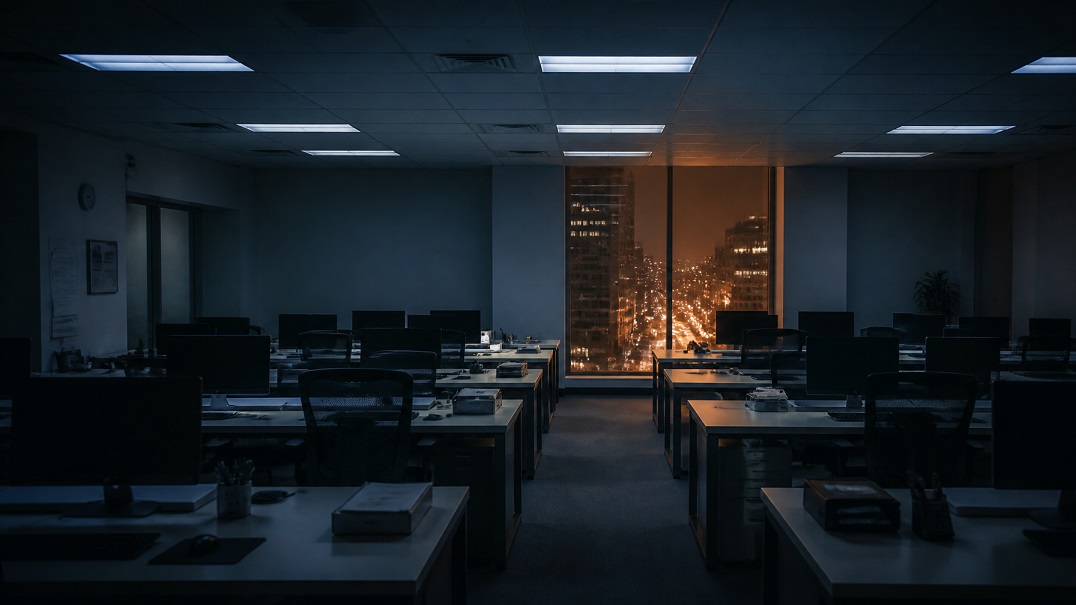
There is a version of office lighting that most people have experienced and none have enjoyed: the flat, bluish-white glare of fluorescent tubes in a ceiling grid, casting shadowless illumination across an open workspace at a color temperature somewhere around 4000 Kelvin. It is the lighting of hospital waiting rooms and supermarket aisles, reproduced in offices at a scale that makes it unavoidable for eight hours a day. It is also, depending on the time of day it is encountered and the specific conditions of its use, either a cognitive asset or a significant cognitive liability — and the difference between those two outcomes has nothing to do with whether the occupants find it aesthetically pleasant.
Light is the primary environmental input that regulates the human circadian system — the approximately 24-hour biological clock that governs sleep-wake timing, hormone secretion, body temperature, and a wide range of cognitive functions that vary predictably across the day. The circadian system is calibrated by light through a dedicated neural pathway that is entirely separate from the visual system used for seeing: specialized photoreceptors in the retina — intrinsically photosensitive retinal ganglion cells (ipRGCs), containing a photopigment called melanopsin — detect light and transmit signals directly to the suprachiasmatic nucleus (SCN) of the hypothalamus, which functions as the master circadian clock. These cells are maximally sensitive to short-wavelength, blue-spectrum light — the same spectrum that dominates both natural daylight and the cooler varieties of artificial lighting used in many offices.
The practical implication of this architecture is that the lighting conditions in which people work are not merely a visual comfort issue. They are a direct input into the neural systems that regulate alertness, hormone secretion, and the timing of cognitive performance peaks and troughs across the day. Getting those conditions wrong does not merely make the office uncomfortable. It can systematically impair cognitive performance, disrupt sleep, and — over time — dysregulate the circadian rhythms on which healthy brain function depends.
Color Temperature: What It Is and Why It Matters
Color temperature is a measurement, expressed in Kelvin, of the spectral composition of a light source — specifically, the relative balance of short-wavelength (blue) and long-wavelength (red and orange) light it emits. Lower color temperatures (2700–3000 K) produce the warm, amber-tinged light associated with incandescent bulbs and candlelight. Higher color temperatures (5000–6500 K) produce the cool, blue-white light associated with overcast daylight and modern LED and fluorescent office lighting. Intermediate temperatures (3500–4500 K) cover a range commonly described as “neutral white.”
The reason color temperature matters for cognition is that melanopsin — the photopigment in the ipRGCs that drives the circadian system — has its peak sensitivity at approximately 480 nanometers, squarely in the blue portion of the visible spectrum. High color temperature lighting, which is rich in short-wavelength blue light, therefore produces stronger ipRGC activation and stronger circadian and alerting effects than warm, low color temperature lighting with equivalent photopic illuminance (the measure of light intensity as perceived by the conventional visual system). Two offices with the same lux level on the desk surface can have dramatically different effects on the occupants’ circadian systems and alertness levels depending on the color temperature of their light sources.
The Alerting Effect of Blue-Enriched Light
Short-wavelength light activates the circadian alerting system through two mechanisms that interact. The first is suppression of melatonin secretion: the pineal gland’s production of melatonin — the hormone that signals darkness and promotes sleep — is inhibited by retinal light exposure in a dose-dependent and wavelength-dependent manner, with blue light producing the strongest suppression at a given intensity. The second is activation of the locus coeruleus — a brainstem nucleus that is the brain’s primary source of norepinephrine — which produces the subjective feeling of alertness and arousal and enhances attentional processing.
A landmark study by Viola and colleagues, published in Scandinavian Journal of Work, Environment and Health in 2008, examined the cognitive and wellbeing effects of blue-enriched white light (approximately 17,000 K) compared to standard white office fluorescent lighting (approximately 4000 K) in a real office environment over a month. Workers under the blue-enriched light reported significantly improved alertness, concentration, and work performance, as well as better sleep quality and mood. Objective performance measures, including reaction time and sustained attention, improved correspondingly. The effect sizes were modest but consistent — the kind of ambient environmental effect that cumulates meaningfully across months and years of daily exposure.
The Time-of-Day Dependency
The alerting effect of blue-enriched light is not uniformly beneficial. It is time-dependent in ways that are central to understanding how artificial lighting should be used across the working day, and that the typical approach of uniform fixed-spectrum office lighting ignores entirely.
In the morning and through midday, blue-enriched light aligns with the natural light environment that the circadian system evolved to expect — daylight at these hours is rich in short-wavelength content, and the circadian system responds to it by suppressing melatonin, elevating cortisol in a healthy diurnal pattern, and increasing the arousal signals that support alertness and cognitive performance. Exposure to blue-enriched artificial light during morning work hours is therefore consistent with circadian biology and produces the alerting and cognitive benefits that the Viola study and others have documented.
In the evening and late afternoon, the same light becomes counterproductive. Natural light at these hours shifts toward warmer, long-wavelength spectra as the sun descends — a signal that the circadian system uses to begin the physiological preparation for sleep. Exposure to blue-enriched artificial light in the hours before sleep suppresses melatonin at precisely the time when melatonin secretion should be rising, delays the circadian clock, reduces sleep quality, and — through the sleep effects described in the commuting article elsewhere in this series — impairs the cognitive performance of the following day. For workers who remain in blue-enriched office environments in the late afternoon, or who continue screen use with high blue-light content into the evening, the lighting of their work environment is actively disrupting the next day’s cognitive capacity.
Illuminance: Brightness as a Separate Variable
Color temperature and illuminance — the overall intensity of light, measured in lux — are related but independent variables, and the research treats them separately. Most offices are lit to between 300 and 500 lux at desk level, a range that meets typical visual task standards but may be substantially below the illuminance levels that produce optimal circadian and cognitive effects. Outdoor daylight ranges from approximately 10,000 lux on an overcast day to over 100,000 lux in direct sunlight — levels that even well-lit offices do not approach. The circadian system evolved in an environment of much higher daytime illuminance than modern offices provide, and the research suggests that this mismatch has cognitive consequences.
High Illuminance and Cognitive Performance
Studies examining the effects of illuminance on cognitive performance have consistently found benefits from higher light levels in the range achievable in office settings. A review by Hygge and Knez published in the Journal of Environmental Psychology examined multiple studies on illuminance and cognitive performance and found that higher illuminance levels improved mood, reduced fatigue, and enhanced performance on tasks requiring sustained attention and processing speed. The effects were particularly pronounced in the morning hours and in winter months, when natural light availability is lowest and the contrast between outdoor and indoor illuminance is greatest.
A study by Smolders and de Kort, published in Lighting Research and Technology in 2014, exposed participants to either low illuminance (200 lux) or high illuminance (1000 lux) at the same color temperature and measured cognitive performance and self-reported vitality across a working day. The high illuminance condition produced significantly better scores on measures of alertness, cognitive performance speed, and self-reported energy — effects that the researchers attributed to enhanced circadian entrainment and increased activation of arousal systems. The lux level in the high-illuminance condition — 1000 lux — is achievable in office environments with appropriate lighting design and is substantially brighter than the 300–500 lux that most offices currently provide.
The Window Problem
Access to windows and natural light is one of the most consistently valued features of office environments in worker preference surveys, and the neuroscience provides a straightforward explanation for why. Natural daylight provides far higher illuminance than artificial lighting for much of the day, shifts naturally in color temperature across the day in a pattern that supports healthy circadian entrainment, and provides additional cognitive benefits through a mechanism unrelated to the circadian system: exposure to natural light through windows also provides views of the outdoor environment, and research on attention restoration theory (ART), developed by Rachel and Stephen Kaplan, suggests that even brief visual exposure to natural environments reduces attentional fatigue by engaging the involuntary attention systems that allow directed attention to recover.
A study by Mohamed Boubekri and colleagues at the University of Illinois, published in the Journal of Clinical Sleep Medicine in 2014, compared workers in windowless offices with those in windowed offices on measures of sleep quality, physical activity, and quality of life. Workers in windowless offices received 173 percent less white light exposure during working hours and slept an average of 46 minutes less per night — a difference that, given the cognitive consequences of chronic sleep restriction, constitutes a significant workplace cognitive health disparity that is determined entirely by office design decisions.
Flicker, Glare, and the Brain’s Hidden Processing Costs
Beyond color temperature and illuminance, two additional properties of artificial lighting impose cognitive costs through mechanisms that operate largely below conscious awareness: flicker and glare.
Flicker and Neural Entrainment
Many fluorescent light sources, particularly older magnetic ballast systems, produce light that flickers at the frequency of the alternating current powering them — 100 or 120 Hz in most countries. At these frequencies, flicker is not consciously perceived by most people; the visual system’s temporal resolution is insufficient to detect it, and the light appears steady. However, research using electroencephalography (EEG) has demonstrated that the brain does respond to subperceptual flicker: neural oscillations in the visual cortex entrain to the flicker frequency, and this entrainment has measurable effects on cognitive processing. Studies have found that exposure to flickering fluorescent light increases the frequency of reported headaches, eye strain, and fatigue relative to flicker-free light sources, even when participants cannot consciously perceive the flicker.
Modern LED lighting, when well-designed, produces negligible flicker — an advantage over fluorescent systems that has genuine cognitive health implications for workers spending extended periods under artificial light. The shift from fluorescent to LED in office environments, if implemented with attention to flicker specification, removes a stressor that has been present in most offices for decades without being widely recognized as such.

Glare and Attentional Depletion
Glare — whether from direct light sources in the visual field or from reflections off screen surfaces and work surfaces — imposes a continuous and largely invisible cognitive cost through the attentional resources required to manage visual discomfort. The visual system’s response to glare involves constant involuntary adjustments in pupil diameter, vergence, and visual attention, each of which consumes a small amount of cognitive resource. Over an eight-hour working day, the cumulative cost of managing persistent glare is not trivial. Research on office glare has found associations between high-glare environments and elevated fatigue, reduced task performance, and increased error rates on visually demanding tasks.
The combination of glare, flicker, and suboptimal color temperature in a typical fluorescent-lit open-plan office constitutes a package of visual stressors whose individual effects are modest but whose aggregate impact across a working day and working year is considerably larger than any single component would suggest. None of these stressors typically rises to the level that workers consciously attribute their fatigue or reduced concentration to the lighting; they are experienced as ambient discomfort rather than specific impairment, which is precisely why they are so rarely addressed.
Dynamic Lighting and the Evidence for Tunable Systems
The research on color temperature, illuminance, and circadian timing converges on a practical design principle: the ideal office lighting system would vary its color temperature and illuminance across the day, matching the higher-intensity, blue-enriched characteristics of natural morning light in the early working hours and shifting toward warmer, lower-intensity spectra in the afternoon. This approach, called dynamic or human-centric lighting, has been implemented in a growing number of workplace studies with consistently positive results.
Circadian-Supportive Lighting in Practice
A 2019 study by Figueiro and colleagues examined the effects of a circadian-supportive lighting system — delivering high, blue-enriched illuminance in the morning and shifting to lower, warmer light in the afternoon — on workers in an office environment, measuring sleep quality, alertness, and cognitive performance over several weeks. Workers under the dynamic system showed significantly improved sleep quality, reduced daytime sleepiness, and better performance on sustained attention tasks compared to those under fixed conventional lighting. The improvements in sleep quality were particularly notable, since they were achieved purely through changes in the daytime lighting environment rather than any intervention in the bedroom or sleep schedule.
The mechanism is direct: morning blue-enriched light produced a stronger circadian alerting signal that advanced the timing of the evening melatonin rise, producing earlier sleep onset and better sleep consolidation. The afternoon shift to warmer light avoided the melatonin-suppressing effects of blue light during the hours when melatonin secretion should be building, supporting the physiological preparation for sleep. The cognitive benefits on the following day followed directly from the improved sleep.
Practical Implications for Office Design
The full implementation of dynamic circadian lighting systems requires investment in tunable LED fixtures and control systems that most existing office buildings do not have. But the research principles translate into practical guidance even for environments with conventional fixed-spectrum lighting. Maximizing exposure to natural daylight — through window proximity, glass partitions, and the placement of workstations near perimeter walls — provides the closest available approximation to the high-illuminance, naturally varying light environment that the circadian system requires. Where natural light is unavailable or insufficient, supplementing with high-illuminance, cool-white task lighting in the morning and reducing reliance on overhead lighting in the afternoon is consistent with the research evidence and achievable with standard equipment.
The broader point is that lighting is not a fixed background condition of the workplace that determines only how well workers can see their screens. It is a continuous input into neural systems that govern alertness, hormone secretion, sleep quality, and cognitive performance — systems that evolved in an environment of dramatically higher and more variable light than most modern offices provide, and that pay a measurable cost when their requirements are met with the flat, uniform, temporally invariant illumination that currently defines most indoor workplaces. Treating lighting as a cognitive performance variable rather than merely a visual comfort standard is one of the highest-leverage, lowest-cost improvements available to most workplace environments. The neuroscience for doing so has been established. The application has simply not kept pace with it.
Your Workplace and Your Brain: Full Series
- Open-Plan Offices vs. Private Offices: What the Research Says About Noise, Interruption, and Cognitive Output
- The Neuroscience of Commuting — What Daily Transit Stress Does to the Brain Over Years
- Artificial Lighting, Color Temperature, and Cognitive Performance — You are here
- Working From Home vs. Office: How the Brain Adapts to Each Environment
- The Cognitive Cost of Hot-Desking and Not Having a Permanent Workspace
- How Plants and Greenery in the Workspace Measurably Improve Cognitive Performance
- Standing Desks and Cognitive Function — What the Evidence Actually Shows