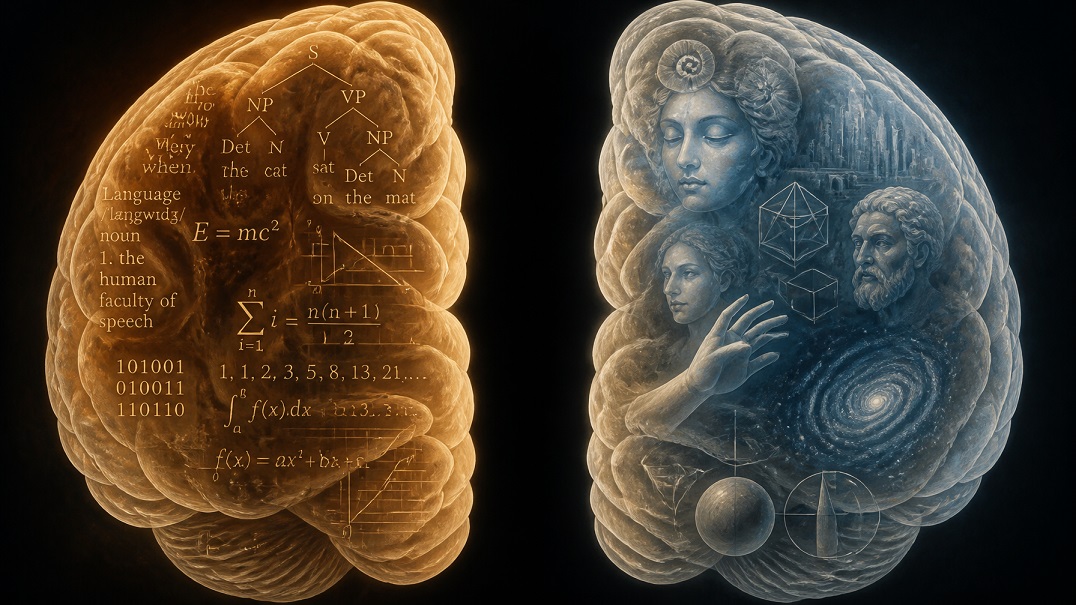
In the early 1960s, a neurosurgeon named Joseph Bogen began performing a radical operation on patients with severe, uncontrollable epilepsy. The procedure involved cutting the corpus callosum — the dense band of approximately 200 million nerve fibers that connects the brain’s left and right hemispheres and serves as the primary communication channel between them. The surgery was based on the hypothesis that epileptic seizures, which involve runaway electrical activity spreading across the brain, might be contained to one hemisphere if the bridge between the two were severed. The hypothesis was correct. For most patients, the surgery dramatically reduced seizure frequency and severity.
The patients appeared, in casual observation, to be entirely normal afterward. They walked, talked, reasoned, and went about their lives in ways that were indistinguishable from before the surgery. Their personalities were unchanged. Their general intelligence was intact. Neurological examination in the ordinary clinical sense found nothing remarkable. If the surgery had produced any significant effect on the mind, it was not obvious.
Then Roger Sperry and his graduate student Michael Gazzaniga began testing them.
What they found, in a series of experiments conducted through the 1960s that would eventually earn Sperry the Nobel Prize in Physiology or Medicine in 1981, overturned a foundational assumption about human consciousness. The assumption was that each person has one mind. The split-brain patients, when examined with the right tests, appeared to have two — two independent streams of perception, intention, and response, coexisting in a single skull, separated by a surgical cut, and almost entirely unaware of each other.
The Architecture of the Divided Brain
Understanding what the split-brain experiments revealed requires understanding the specific way the human brain’s visual and motor systems are organized, because the experimental design depended entirely on that organization.
Crossed Wiring: What Each Hemisphere Receives
The human brain is contralaterally organized: each hemisphere primarily controls the opposite side of the body and receives sensory input primarily from the opposite side of the world. The left hemisphere controls the right hand and receives visual information from the right visual field — the right half of what both eyes can see. The right hemisphere controls the left hand and receives visual information from the left visual field. This crossing happens at specific anatomical junctions: motor fibers cross in the brainstem, and visual fibers cross at the optic chiasm.
In a brain with an intact corpus callosum, this crossed organization is invisible in everyday function because information received by one hemisphere is immediately shared with the other across the callosal fibers. The left hand knows what the right hand is doing because the corpus callosum tells it. In a split-brain patient, that communication channel is gone. Information delivered to one visual field reaches only the hemisphere that receives it and stays there. What the left hemisphere knows, the right hemisphere does not — and vice versa.
The Experimental Setup
Sperry and Gazzaniga exploited this anatomy with elegant precision. Patients were seated before a screen and instructed to fix their gaze on a central point. Images or words were then flashed briefly — for fractions of a second, too fast for the eyes to move to capture them — to either the left or the right visual field. Because the exposure was too brief for eye movement, the information went exclusively to the contralateral hemisphere: images flashed to the right visual field reached only the left hemisphere, and images flashed to the left visual field reached only the right hemisphere. The patients were then asked to report what they had seen, or to respond with their hands.
The results of this simple setup were extraordinary, and they were consistent across patients and across years of testing.
What the Experiments Found
When a word or image was flashed to the right visual field — processed by the left hemisphere, which in most people contains the primary language centers — the patient could describe it verbally without difficulty. Ask what they saw, and they told you. When the same word or image was flashed to the left visual field — processed by the right hemisphere, which in most people has limited language production capacity — the patient said they saw nothing. They reported a blank screen. The verbal report, produced by the left hemisphere, was honest: the left hemisphere genuinely had not received the information.
But the right hemisphere had received it. And the right hemisphere could demonstrate this, if given a non-verbal means of response. If asked to use the left hand to pick an object from a hidden collection — objects the patient could feel but not see — the left hand, controlled by the right hemisphere, reliably selected the object that matched what had been flashed to the left visual field. The right hemisphere knew. It simply could not say so.
The Talking Hemisphere and the Silent One
The asymmetry between the hemispheres’ linguistic capacities shaped everything about how the split-brain experiments worked and how their results were interpreted. In the overwhelming majority of right-handed people, and a significant majority of left-handed people, the left hemisphere is the dominant language hemisphere — the seat of verbal expression, grammatical processing, and the production of speech. The right hemisphere, in most people, understands language to a significant degree but produces it only minimally. It can recognize words, understand simple commands, and respond to verbal input, but it cannot generate fluent speech.
This meant that in split-brain experiments, the patient’s verbal report always reflected the left hemisphere’s experience — the left hemisphere’s perceptions, intentions, and knowledge — while the right hemisphere’s separate experience was invisible to ordinary conversation. The right hemisphere communicated through action: through the left hand, through pointing, through selecting objects. When it was given the opportunity to communicate this way, it demonstrated knowledge, preferences, and even emotional responses that the left hemisphere — the speaking self — was entirely unaware of.
The Chimeric Face Experiments
Among the most striking demonstrations of hemispheric independence were the chimeric face experiments, in which photographs composed of the left half of one face and the right half of another were presented to split-brain patients. When asked verbally to identify the face they had seen — a question answered by the left hemisphere, which had processed the right half of the composite — patients named the face corresponding to the right half. When asked to point with the left hand to a photograph of the face they had seen — a response controlled by the right hemisphere, which had processed the left half of the composite — they pointed to a different face entirely. Each hemisphere had seen a different face and was confident of its own answer. Neither was aware of the other’s different experience.

The Left Hand That Disagreed
The behavioral consequences of having two independently processing hemispheres extended beyond the laboratory. Some split-brain patients reported episodes of what neurologists called intermanual conflict — situations in which the two hands appeared to work at cross-purposes. One patient reported that his left hand would sometimes reach out and grab his wife’s arm when his right hand was trying to push her away during an argument. Another described his left hand unbuttoning his shirt as his right hand buttoned it. These were not fabrications or post-hoc rationalizations; they were consistent with the experimental findings that the two hemispheres could hold different intentions simultaneously and that each could act on its own intentions through its corresponding hand.
The left hand that acted against the patient’s stated intentions was not a malfunctioning hand. It was a hand under the direction of a hemisphere with its own agenda — one that the speaking, reporting, socially present left hemisphere did not share and could not override.
The Interpreter: How the Left Brain Explains Itself
One of Gazzaniga’s most consequential findings emerged from experiments in which the left hemisphere was asked to explain behavior that had actually been initiated by the right hemisphere. The setup involved giving the right hemisphere a command through the left visual field — something like “stand up” or “laugh” — and then asking the patient (that is, the left hemisphere) why they had done it. The left hemisphere, having no access to the command the right hemisphere had received, could not know the real reason. But it did not say “I don’t know.” It confabulated — instantly and fluently constructing a plausible-sounding explanation for a behavior whose actual cause it was completely unaware of.
Asked why he had stood up, a patient who had received the command “stand up” in his right visual field might say he had wanted to stretch his legs. Asked why he was laughing, a patient who had received a joke in his right visual field might attribute the laughter to something in the room. The explanations were delivered with complete confidence and without any apparent awareness that they were confabulations. The left hemisphere, denied the truth, generated a narrative that fit the behavior and presented it as if it were memory.
Gazzaniga named the neural system responsible for this behavior the interpreter — a left-hemisphere mechanism that constantly constructs coherent narratives about the self’s behavior and experience, drawing on whatever information is available and filling the gaps with plausible inference. He argued that this interpreter is not unique to split-brain patients but is a standard feature of the left hemisphere in all people — that the sense of being a unified, coherent self with continuous reasons for one’s actions is, in significant part, a narrative produced after the fact by a system whose primary function is to make behavior feel explicable and intentional, regardless of whether it was.
The Consciousness Question
The philosophical implications of the split-brain findings were immediately recognized as profound and have not diminished with time. The most direct implication is that the unity of consciousness — the sense that there is a single, unified “I” having a single stream of experience — is not a metaphysical given but a product of brain architecture. Specifically, it appears to depend on the continuous cross-hemispheric communication that the corpus callosum provides. When that communication is severed, two streams of processing that are normally integrated into a single experience appear to separate into two independent streams, each with its own perceptions, its own knowledge, and its own behavioral intentions.
Are Split-Brain Patients Two People?
This question has been seriously debated by philosophers of mind since the split-brain findings became widely known in the late 1960s. The philosopher Thomas Nagel argued in a 1971 paper that the split-brain data was genuinely incompatible with the claim that each patient remained a single unified subject of experience — that the data implied, at minimum, two simultaneous streams of consciousness in one body. The philosopher Derek Parfit drew on split-brain findings extensively in Reasons and Persons (1984) to argue against the ordinary view of personal identity as a simple, indivisible fact.
The opposing view — that split-brain patients remain single, unified persons despite the experimental findings — has also been defended. A 2017 paper by Yair Pinto and colleagues, published in Brain, argued that split-brain patients show a unified conscious perception in everyday life even when their responses in laboratory settings appear divided, and that the divided responses reflect a divided motor output system rather than divided consciousness per se. The patients themselves, when asked, report feeling like one person — though the philosophical weight of that self-report is itself contested, given that only one hemisphere is producing it.
The debate has not been resolved, and it may not be resolvable with currently available methods. What the split-brain findings have established beyond reasonable dispute is that the unity of consciousness is not something the brain simply has; it is something the brain achieves, through specific anatomical connections, and it can be disrupted when those connections are cut.
What This Means for the Normal Brain
The lesson the split-brain patients offer about ordinary human consciousness is uncomfortable but important. The unified self — the “I” that seems to be the obvious and unquestionable author of one’s actions and the owner of one’s experiences — is, on the evidence, a construction. The left hemisphere’s interpreter system generates a continuous narrative of coherent selfhood, and it generates that narrative whether or not it has accurate information about the causes of the behavior it is narrating. In the split-brain patient, this is visible because the right hemisphere’s contributions are experimentally isolated and the confabulation is demonstrable. In the neurologically typical person, the same process operates, but there is no experimental method to isolate and expose it.
The implication — that a significant portion of what we experience as conscious intention and rational self-knowledge may be post-hoc narrative rather than accurate report — is one that neuroscience has approached from multiple directions since Sperry and Gazzaniga’s original work, and it has not become less troubling with familiarity. The split-brain patients did not reveal something exotic about a rare surgical condition. They revealed something about the structure of human consciousness that applies, in modified form, to everyone. The corpus callosum in a typical brain does not eliminate the interpreter; it simply ensures that the interpreter has more information to work with, and that its narratives are harder to expose as confabulations.
Michael Gazzaniga and the Decades After
Michael Gazzaniga, who began the split-brain research as Sperry’s graduate student and outlived his mentor by decades, spent his career extending and refining the original findings. His work on the interpreter hypothesis, developed through the 1980s and 1990s, became one of the most influential frameworks in cognitive neuroscience for understanding how the brain produces the sense of a unified self. His 2011 book Who’s in Charge? Free Will and the Science of the Brain laid out the implications of split-brain research for questions of agency and responsibility in terms accessible to a general readership.
Gazzaniga has consistently argued against the interpretation that split-brain patients are literally two people, preferring a framework in which the dominant left hemisphere constitutes the primary conscious agent and the right hemisphere operates as a sophisticated but subordinate processing system. Not all of his colleagues have accepted this framing; the debate about what split-brain data implies for theories of consciousness continues in the philosophical and neuroscientific literature.
What is not debated is the significance of what Sperry, Gazzaniga, and Bogen discovered, however one interprets it. Before their work, the unity of consciousness was generally assumed to be a fundamental feature of mind — something that did not require explanation because it was simply obvious. The split-brain patients made it an empirical question. And empirical questions, as neuroscience has shown repeatedly, do not always return the answers that common sense anticipates.
Extreme Brain Cases: Full Series
- Acquired Savant Syndrome — People Who Develop Extraordinary Cognitive Abilities After Brain Injury
- Hyperthymesia: The Condition of Perfect Autobiographical Memory (and Why It Is Not As Desirable as It Sounds)
- The Split-Brain Patients: What Severing the Corpus Callosum Reveals About Consciousness — You are here
- Blindsight: Patients Who Are Clinically Blind but Can Navigate Obstacles — What It Tells Us About Visual Consciousness
- Foreign Accent Syndrome: Why Some Brain Injuries Cause People To Speak in Different Accents
- People Who Feel No Fear: The Case of Patient SM and the Amygdala
- Terminal Lucidity: The Unexplained Phenomenon of Dementia Patients Regaining Full Clarity Hours Before Death
- Capgras Delusion: Believing a Loved One Has Been Replaced by an Identical Impostor
- The Man With Almost No Cerebral Cortex Who Had a Measured IQ of 126