In the 1970s, a neurologist named Lawrence Weiskrantz was testing a patient known in the literature as DB, who had undergone surgery to remove a tumor from his right primary visual cortex — the region of the occipital lobe where visual information from the eyes is first processed into conscious perception. The surgery had left DB clinically blind in the left half of his visual field. If you held up an object to his left, he reported seeing nothing. He was not mistaken and not feigning. As far as his conscious experience was concerned, his left visual field was simply absent — a void where half the world had been.
Weiskrantz asked DB to guess. He pointed to a location in DB’s blind field and asked him to reach out and touch it, despite seeing nothing there. DB protested that the exercise was pointless — he couldn’t see anything, so how could he possibly locate it? Weiskrantz insisted. DB reached out. His hand landed on or very near the target, at a rate far above what random chance would predict. He was then asked to guess the orientation of a line he could not see. He guessed correctly, repeatedly, at rates that were statistically impossible to attribute to luck. He was shown an X and an O in his blind field and asked to choose between them. He chose correctly.
When Weiskrantz showed DB his own performance data — the graphs of accuracy that demonstrated he was responding correctly to stimuli he experienced as invisible — DB was, by all accounts, genuinely astonished. He had no sense of guessing accurately. He had no sense of receiving any information. His subjective experience was of absolute blindness. And yet something in his brain was seeing.
Weiskrantz named the phenomenon blindsight, and its implications for understanding the relationship between vision and consciousness are as deep as anything neuroscience has produced. The split-brain experiments, discussed elsewhere in this series, suggested that consciousness could be divided. Blindsight suggests something more radical: that sophisticated visual processing — enough to locate objects, discriminate shapes, detect motion, and even recognize emotional expressions — can occur entirely without consciousness. Vision and the experience of seeing, it turns out, are not the same thing.
What Causes Blindsight
To understand blindsight, it helps to understand what the primary visual cortex does and what happens when it is destroyed. Vision begins at the retina, where photoreceptors convert light into electrical signals that travel along the optic nerve to the brain. At the optic chiasm, fibers from the nasal half of each retina cross to the opposite hemisphere, while fibers from the temporal half remain ipsilateral — an arrangement that means each hemisphere receives visual information from the contralateral visual field. These signals are routed first to the lateral geniculate nucleus (LGN) of the thalamus, which acts as a relay station, and from there to the primary visual cortex, also called V1 or the striate cortex, located at the back of the occipital lobe.
The Primary Visual Cortex and Its Destruction
V1 has traditionally been considered the gateway to conscious visual experience — the region where raw visual signals are transformed into the representations that give rise to the experience of seeing. When V1 is destroyed by stroke, surgery, or injury in a specific region, the corresponding part of the visual field goes blind. This blindness is called cortical blindness to distinguish it from blindness caused by damage to the eyes or optic nerves. It is absolute in the sense that no visual information reaches conscious awareness from the affected field region. Patients reliably report seeing nothing there, and standard clinical testing confirms the absence of conscious visual experience.
What was not understood before Weiskrantz’s work with DB is that cortical blindness is not the same as the complete absence of visual processing. V1 is not the only destination for visual signals leaving the thalamus. There are parallel pathways — older in evolutionary terms, less elaborate in their processing, but still functional — that route visual information to other brain structures without passing through V1 at all.
The Superior Colliculus and the Subcortical Route
The most important alternative visual pathway runs from the retina through the superior colliculus — a structure in the midbrain that in non-mammalian vertebrates serves as the primary visual processing center — and from there to the pulvinar nucleus of the thalamus, and on to visual association areas in the parietal and temporal cortex. This pathway bypasses V1 entirely. It is less capable than the primary visual pathway of supporting high-resolution, color-discriminating, detail-rich conscious vision. But it is capable of processing location, motion, basic shape, and — as subsequent research would establish — a surprising range of more complex visual features including facial emotional expression.
Blindsight occurs when V1 is damaged but these subcortical pathways remain intact. The patient’s primary visual cortex cannot process the incoming signals and cannot generate conscious visual experience. But the subcortical route continues to deliver visual information to parietal and temporal structures that can guide behavior. The result is a patient who is genuinely blind in conscious experience but whose visual system is nonetheless receiving and acting on information from the blind field — information the patient cannot access, report, or even, in most cases, suspect is there.
The Varieties of Blindsight
Since Weiskrantz’s original work with DB, blindsight has been documented in dozens of patients and studied with increasing sophistication. The phenomenon turns out to be considerably more complex than the initial findings suggested, and researchers have identified distinct types and capacities within it.
Type 1 and Type 2 Blindsight
The distinction most commonly drawn in the clinical literature is between Type 1 blindsight, in which the patient reports no experience whatsoever of the stimuli they nonetheless respond to accurately, and Type 2 blindsight, in which the patient reports some vague, non-visual awareness — a feeling, a hunch, or a sense that something is present — without any visual experience proper. Type 2 blindsight is rarer and more controversial; its existence suggests a spectrum between complete unconscious processing and full conscious vision, with intermediate states that do not fit neatly into either category. Some researchers have questioned whether Type 2 represents genuine partial consciousness or simply a form of response bias — a tendency to report something when the experimental situation implies something should be there.
What Blindsight Can and Cannot Detect
The range of visual information accessible through blindsight has been progressively mapped, and it is more extensive than early studies suggested. Blindsight patients can accurately indicate the location of stimuli in their blind field, discriminate between moving and stationary stimuli, detect the orientation of gratings, distinguish between simple geometric shapes, and in some cases make above-chance discriminations of color. They can detect the direction of motion with high accuracy. They show differential responses to stimuli that would normally be frightening — a snake or a threatening face — even when they report no conscious awareness of seeing anything.
The emotional response finding is particularly significant. Research by Alan de Gelder and colleagues has demonstrated that blindsight patients respond behaviorally and physiologically to the emotional content of faces presented in their blind field — their skin conductance changes, their posture adjusts, their response times are affected — despite reporting no visual experience. The brain is not only locating objects and detecting motion without consciousness; it is evaluating social and emotional meaning without consciousness. The implication is that a substantial portion of the social processing that humans perform visually may operate below the threshold of awareness even in neurologically typical people.

One of the most extensively studied blindsight patients in the literature is a British man identified as GY, who sustained damage to his left visual cortex at age eight following a road accident and has been studied by multiple research groups over several decades. GY is blind in his right visual field and has been a remarkably cooperative and insightful research subject, capable of describing his experience with unusual precision and willing to participate in increasingly demanding experimental tasks.
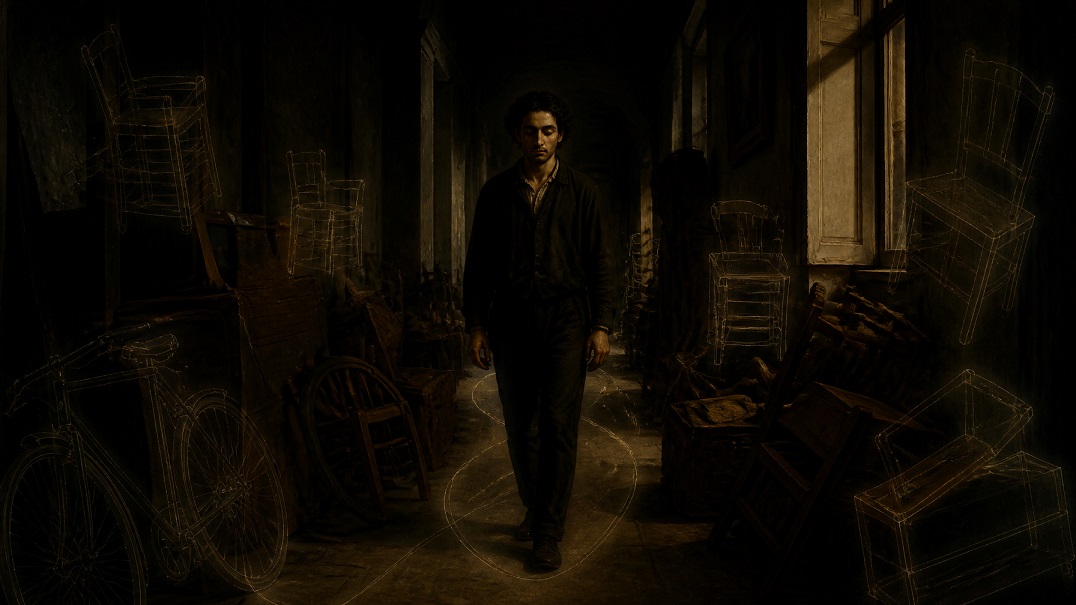
In one celebrated series of experiments, GY was asked to walk down a corridor that had been cluttered with obstacles in his blind field. He navigated it successfully — adjusting his path to avoid obstacles he reported not seeing, with an accuracy that far exceeded chance. The experience from GY’s perspective, as he described it, was of walking a clear corridor while his body somehow found its way around things that weren’t, from his point of view, there. He found the experience deeply unsettling in ways that DB had also described. Knowing that your behavior is being guided by information your consciousness cannot access is, by all accounts, a profoundly disorienting form of self-alienation.
Blindsight in Neurologically Typical People
One of the most productive directions in blindsight research has been the investigation of whether analogous processes operate in people without any visual cortex damage — whether, that is, unconscious visual processing is a feature of all human brains rather than an artifact of specific injury. The evidence suggests that it is.
Inattentional Blindness and the Invisible Gorilla
The most famous demonstration of unconscious visual processing failure in typical people is the inattentional blindness paradigm, established by Daniel Simons and Christopher Chabris in their 1999 gorilla experiment: subjects instructed to count basketball passes between players in a video failed, in large numbers, to notice a person in a gorilla suit walking through the frame. Their visual systems received and processed the gorilla — the retinal image was clear, the signal reached the cortex — but it did not reach conscious awareness because attention was directed elsewhere. This is not blindsight in the clinical sense, but it demonstrates that the relationship between visual processing and visual awareness is not obligatory even in healthy brains: the brain can process visual information without that information becoming conscious.
Subliminal Visual Processing
Decades of research on subliminal perception have established that visual stimuli presented below the threshold of conscious awareness — too briefly or too faintly to be consciously perceived — nonetheless influence subsequent behavior, emotional state, and cognitive processing. Subliminally presented faces influence affective judgments. Subliminally presented words prime subsequent word recognition. Subliminally presented threatening stimuli produce measurable physiological responses. The mechanisms involved overlap substantially with those implicated in blindsight: visual information reaches processing systems that influence behavior without reaching the systems that generate conscious experience.
What Blindsight Tells Us About Consciousness
The theoretical significance of blindsight for understanding consciousness is difficult to overstate. Before blindsight was characterized, it was reasonable to assume that visual processing and visual consciousness were the same thing — that when the brain processed a visual stimulus, the result was visual experience, and when no experience occurred, no processing had taken place. Blindsight demolished this assumption. Processing and experience are dissociable. The brain can do an enormous amount with visual information without that information ever appearing in consciousness.
The Two Visual Streams
Blindsight research contributed significantly to the development of the two visual streams hypothesis, proposed by Melvyn Goodale and David Milner in a landmark 1992 paper in Brain. They argued that the visual system is organized into two functionally distinct processing streams emerging from V1: the ventral stream, running toward the temporal lobe, which processes the identity and meaning of objects and supports conscious visual recognition; and the dorsal stream, running toward the parietal lobe, which processes the spatial location and properties of objects for the purpose of guiding action. The dorsal stream operates largely unconsciously and is the pathway most directly involved in blindsight — it receives input from the subcortical routes and drives behavioral responses to stimuli that never reach conscious ventral processing.
The two streams hypothesis has become one of the most influential frameworks in visual neuroscience and has implications well beyond blindsight. It suggests that the visual information supporting conscious recognition — the information that allows you to say what you are seeing — is systematically different from the visual information guiding your hands as you reach for an object. The hand knows things the conscious mind does not, and it is drawing on a different visual representation to act on that knowledge.
The Hard Problem, Again
Blindsight bears directly on the hard problem of consciousness — the question of why any physical process should produce subjective experience — in a way that makes the problem more pointed rather than less. If the brain can perform sophisticated visual processing without generating any experience, then the relationship between processing and experience is not necessary but contingent. Something additional is required to convert neural processing into conscious awareness, and the thing that is added is not more processing of the same kind — blindsight patients have processing — but something of a different nature that current neuroscience cannot fully specify.
This is the deepest implication of blindsight, and it connects to the consciousness question raised in the split-brain research discussed elsewhere in this series. The split-brain findings suggested that consciousness can be divided. Blindsight suggests it can be entirely absent from processing that is, in behavioral terms, highly functional. Taken together, the two phenomena undermine any simple identification of brain activity with conscious experience and push the question of what consciousness actually is — and what it is for — to the center of neuroscience’s unfinished agenda.
DB, the patient who started it all, was reportedly unsettled for years after Weiskrantz showed him his own accuracy data. The experience of learning that your brain is doing things your consciousness knows nothing about — that you are, in some measurable sense, responding to a world you cannot see — is not easily assimilated into ordinary notions of self and experience. DB’s discomfort was philosophically appropriate. What Weiskrantz had shown him was not merely a clinical curiosity. It was evidence that the relationship between his brain and his conscious self was less complete, less transparent, and less under his awareness than he had ever had reason to suspect. The same is true, to a degree that blindsight research makes increasingly difficult to ignore, for all of us.
Extreme Brain Cases: Full Series
- Acquired Savant Syndrome — People Who Develop Extraordinary Cognitive Abilities After Brain Injury
- Hyperthymesia: The Condition of Perfect Autobiographical Memory (and Why It Is Not As Desirable as It Sounds)
- The Split-Brain Patients: What Severing the Corpus Callosum Reveals About Consciousness
- Blindsight: Patients Who Are Clinically Blind but Can Navigate Obstacles — What It Tells Us About Visual Consciousness — You are here
- Foreign Accent Syndrome: Why Some Brain Injuries Cause People To Speak in Different Accents
- People Who Feel No Fear: The Case of Patient SM and the Amygdala
- Terminal Lucidity: The Unexplained Phenomenon of Dementia Patients Regaining Full Clarity Hours Before Death
- Capgras Delusion: Believing a Loved One Has Been Replaced by an Identical Impostor
- The Man With Almost No Cerebral Cortex Who Had a Measured IQ of 126