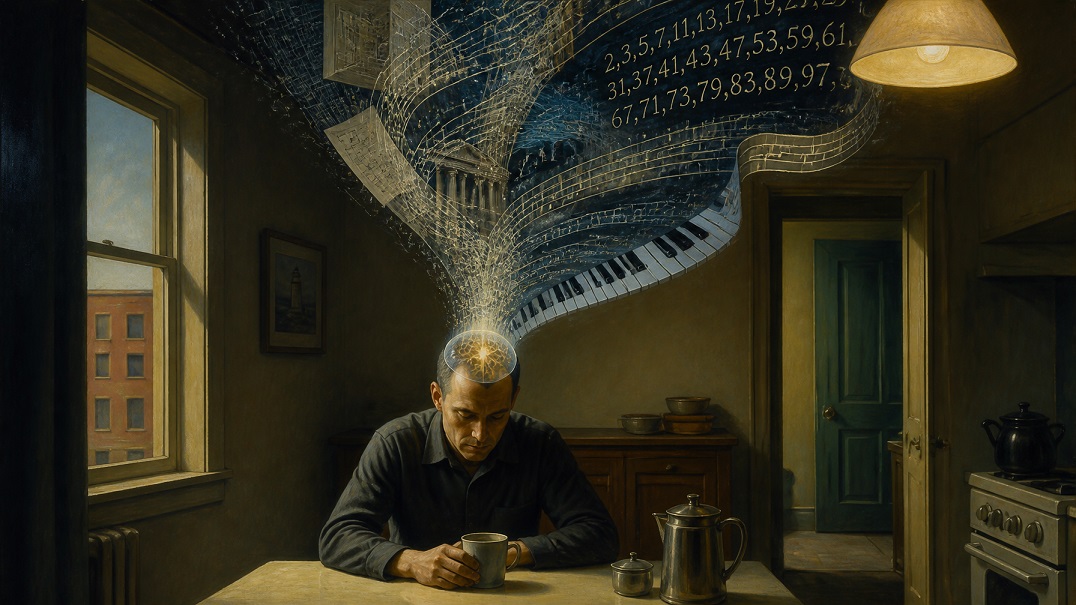
In 2002, a 10-year-old boy named Orlando Serrell was struck on the left side of his head by a baseball. He fell, recovered after a brief headache, and told no one about the incident for months. What he eventually told his parents, when it became impossible to ignore, was this: he could now recall, in precise detail, every day since the moment of the injury. Ask him what day of the week any date falls on — past, present, or future — and he provides the answer in seconds, along with what the weather was like, what he ate, and whatever else happened that particular day. Before the baseball, he had no such ability. He has had it ever since.
Serrell is one of several dozen documented cases of acquired savant syndrome — a phenomenon in which ordinary people, following injury to the brain, develop extraordinary cognitive abilities that were entirely absent before the injury. The abilities that emerge are characteristic: a narrow range of skills that appear with uncanny consistency across cases — calendar calculation, artistic or musical ability of sudden and exceptional quality, mathematical computation, and hyperdimensional memory. The people who develop them are typically not otherwise changed in obvious ways. They were not geniuses before. Many of them experienced no prior interest in the skill that suddenly became available to them.
Acquired savant syndrome is among the most philosophically provocative phenomena in all of neuroscience, because it raises a question that has no comfortable answer: if these abilities can appear suddenly, in ordinary people, following injury — abilities that took others decades of practice to approach — were those abilities latent all along? Is the capacity for extraordinary cognition something the human brain routinely contains and routinely suppresses? And if so, why?
The Landscape of Savant Abilities
Before considering the acquired form, it helps to understand the broader phenomenon of savant syndrome, of which acquired savant is a rare subset. Savant syndrome — first systematically described by the British physician J. Langdon Down in 1887, who coined the term “idiot savant” in the terminology of his era — refers to the co-occurrence of developmental disability or neurological difference and exceptional cognitive ability in a specific, narrow domain. The abilities seen in savants are remarkably consistent across individuals and across cultures, clustering in a small number of categories.
The Characteristic Savant Skills
Calendar calculation — the ability to rapidly determine the day of the week for any date, past or future, across centuries — is perhaps the most widely documented savant skill and the one that most reliably appears in acquired cases. It requires no obvious practical application and yet emerges spontaneously, apparently fully formed, in people who have undergone certain brain changes. No one knows precisely what cognitive mechanism underlies it; the patterns in calendar structure are regular enough to be encoded in an algorithm, but savant calendar calculators do not appear to be running a conscious algorithm — they report experiencing the answer as direct perception rather than computation.
Artistic ability — particularly visual art and music — is the second major category. Cases of acquired artistic ability following brain injury are well documented. Some involve people who had no prior interest in art; others involve people with modest prior interest who develop output of sudden and striking quality. The content and style of post-injury art tends toward the obsessive and highly detailed — intricate architectural drawings, compulsively precise cityscapes, mathematical patterns rendered in visual form — suggesting that whatever is being released is not general artistic creativity but a specific mode of perception and replication.
Mathematical ability — performing rapid mental arithmetic, identifying prime numbers, computing large powers — appears in both congenital and acquired savants. Memory of an exceptional and specific kind, including the ability to memorize entire telephone directories, reproduce long musical pieces after a single hearing, or recall in detail every day of one’s life, is another consistent feature. The key characteristic of all savant abilities, whether congenital or acquired, is their narrowness: the abilities are precisely bounded, often linked to pattern, repetition, or exact replication, and rarely involve the flexible creative application that characterizes high general intelligence.
Acquired Savant: The Cases
Acquired savant syndrome is considerably rarer than the congenital variety and has been documented systematically only since the late 20th century, as the neuroscientific and neuroimaging tools needed to study it became available. The leading researcher in the field has been the American psychiatrist Darold Treffert, whose decades of work on savant syndrome produced the most comprehensive clinical literature on the phenomenon. Several individual cases have been studied in sufficient depth to offer genuine scientific insight.
Derek Amato: Accidental Musician
In 2006, Derek Amato, a 40-year-old American with no significant musical training, dived into the shallow end of a swimming pool, struck his head on the bottom, and sustained a severe concussion and partial hearing loss. Several days later, sitting at a friend’s piano for the first time in his life, he found that he could play. Not haltingly, not experimentally — he played for hours, with fluency and emotional expressiveness that people who heard him described as extraordinary. He reported seeing moving black and white squares in his visual field as he played, which appeared to correspond to the notes he produced. He has been composing and performing music since the injury, with no formal training at any point in that process. Neurological examination revealed damage to the left anterior temporal lobe, a region whose suppression has been hypothesized as a mechanism for savant emergence in multiple cases.
Tommy McHugh: The Poet and Painter
Tommy McHugh was a 51-year-old British former drug user with no artistic background when he suffered a subarachnoid hemorrhage in 2001. Following his recovery, he was compelled — a word he and those around him used consistently — to write poetry and create visual art. The compulsion was not casual: he covered the walls, floors, and ceilings of his home with paintings and wrote thousands of poems. His work was exhibited in galleries and attracted the attention of researchers including the neuroscientist Semir Zeki. Neuroimaging showed bilateral frontal lobe damage, and the case contributed to the hypothesis that frontal lobe disinhibition — the release of posterior sensory and pattern-recognition systems from frontal inhibitory control — is a mechanism of savant emergence.
Jason Padgett: The Mathematical Vision
Jason Padgett was a furniture salesman in Tacoma, Washington, with no interest in mathematics when he was attacked and robbed outside a karaoke bar in 2002, suffering a severe concussion. He subsequently developed synesthesia — a perceptual blending of senses — and began seeing the world as composed of geometric forms and fractal patterns. He started drawing intricate hand-drawn geometric figures with a precision that attracted the attention of mathematicians, who recognized in his drawings accurate representations of mathematical concepts he had never formally studied. He later enrolled in university mathematics courses and has been able to provide mathematical justification for the geometric forms his perception generates spontaneously. Brain imaging conducted by researchers at Baylor University showed unusual neural activity in the left hemisphere consistent with savant processing. His case is unusual in that it involves an apparent integration of the savant ability with conceptual understanding, rather than the pure procedural production more typical of savant skills.

The Neuroscience: What Is Happening in the Brain
Several competing hypotheses attempt to account for acquired savant syndrome, none of which is fully established but all of which are supported by at least some of the available evidence. They are not mutually exclusive.
The Disinhibition Hypothesis
The most widely cited framework is the disinhibition hypothesis, developed principally by the neuroscientist Allan Snyder at the University of Sydney. Snyder argues that the left anterior temporal lobe — the region most consistently implicated in acquired savant cases — normally exerts inhibitory control over the more literal, detail-oriented processing that occurs in the right posterior parietal and occipital regions. This inhibition is adaptive: it allows the brain to process the world conceptually, at the level of meaning and category, rather than getting lost in raw perceptual detail. A face is recognized as a face rather than experienced as a complex arrangement of skin texture, shadow, and color; a melody is heard as a tune rather than as a sequence of discrete acoustic events.
When left anterior temporal inhibition is reduced — whether by injury, disease, or experimental intervention — the right posterior processing systems are partially released, and access to low-level perceptual and pattern-recognition detail becomes available in a way it normally is not. The savant’s unusual abilities, on this account, are not something added to the brain; they are something uncovered, as normal top-down conceptual processing is partially lifted. Snyder has attempted to test this hypothesis using transcranial magnetic stimulation (TMS) to temporarily suppress left anterior temporal activity in neurologically typical volunteers, and has reported findings of transient savant-like effects in some subjects — improvements on specific tasks including proofreading and drawing — though these findings have not been consistently replicated by independent groups.
Neural Reorganization and Recruitment
An alternative or complementary hypothesis holds that brain injury triggers compensatory neural reorganization — the recruitment of undamaged neural tissue to perform functions previously handled by damaged regions, sometimes with unexpected results. On this account, the savant abilities that emerge after injury are not latent in every brain but are the product of the particular reorganization that follows a particular injury in a particular individual. The consistency of savant abilities across cases, on this view, reflects the consistency of the brain regions most commonly damaged by the kinds of head injuries that produce acquired savant syndrome, rather than a universal latent capacity.
The Latent Potential Question
The debate between these hypotheses has direct implications for one of the most interesting questions the phenomenon raises: whether savant-level abilities are latent in neurologically typical people. Snyder’s disinhibition hypothesis implies that they are — that the brain of every person contains the raw processing capacity for calendar calculation, precise visual memory, or other savant skills, and that these capacities are normally suppressed because conceptual, top-down processing is more adaptive for everyday functioning. If this is correct, then the savant’s gift is not possession of something rare but release from something universal.
The neural reorganization hypothesis, by contrast, implies that acquired savant abilities are idiosyncratic products of specific brain configurations that happen to arise from injury — not universally latent but contingently available. The truth is likely more complicated than either simple account, and the evidence currently available does not decisively favor one over the other.
Frontotemporal Dementia and the Emergence of Art
Among the most striking population of acquired savants are patients with frontotemporal dementia (FTD) — a neurodegenerative disease that progressively destroys frontal and temporal lobe tissue. A subset of FTD patients, as their disease progresses and frontal lobe function declines, develop new and sometimes remarkable visual artistic abilities. This was documented systematically by the neurologist Bruce Miller and colleagues at the University of California, San Francisco, in a series of papers beginning in the 1990s. The patients Miller studied had no prior artistic interest or training; several produced work during their illness that was exhibited in galleries and sold for significant sums. As the disease progressed and destroyed more neural tissue, the artistic abilities eventually disappeared along with other functions.
These cases are particularly important for the disinhibition hypothesis because they occur in the context of a disease, not a discrete injury, and they follow a predictable pattern: the emergence of artistic ability correlates with the progressive loss of left frontotemporal tissue and is associated with preserved or even enhanced right posterior function. The pattern is consistent enough across patients to suggest a genuine mechanism rather than coincidence. It also carries a particular poignancy: the artistic flowering occurs as the person who produces it is losing the cognitive capacities that would allow full appreciation of what they are creating.
What Acquired Savant Syndrome Tells Us About the Normal Brain
The value of extreme cases in neuroscience lies in what they reveal about normal function — the way that a system’s architecture becomes visible when part of it fails. Acquired savant syndrome, viewed through this lens, suggests several things about the brain that are not obvious from studying the brain when it is working in its ordinary way.
First, it suggests that the normal brain is not operating at the ceiling of its processing capacity in any simple sense. The appearance of abilities that vastly exceed prior performance, following injury that removes tissue rather than adding it, is difficult to explain if the normal brain is already using all of its available capacity. Something is being released, not created. What exactly is being released — and why the normal brain holds it back — remains one of the genuinely open questions at the edge of current neuroscience.
Second, it suggests that the relationship between intelligence and cognitive ability is not straightforward. The people who develop acquired savant abilities are not, in general, people of extraordinary general intelligence, and the abilities themselves are not expressions of general intelligence. They are narrow, specific, and in some ways opposite to the flexible, generative quality of high general intelligence. This dissociation — extreme ability in a narrow domain, coexisting with ordinary or below-ordinary general function — challenges any simple account of what the brain is doing when it performs well.
Third, and perhaps most provocatively, it raises a question about the nature of human potential that cannot yet be answered but cannot be dismissed. Orlando Serrell has perfect calendar calculation and perfect autobiographical memory because a baseball struck his head. Derek Amato can play piano with the fluency of a trained musician because he hit the bottom of a swimming pool. The abilities were not learned. They appeared. Whatever account of the brain is ultimately correct, it will need to explain that — and the explanation, when it comes, will almost certainly change how we understand what ordinary human cognition is and what it is capable of becoming.
Extreme Brain Cases: Full Series
- Acquired Savant Syndrome — People Who Develop Extraordinary Cognitive Abilities After Brain Injury — You are here
- Hyperthymesia: The Condition of Perfect Autobiographical Memory (and Why It Is Not As Desirable as It Sounds)
- The Split-Brain Patients: What Severing the Corpus Callosum Reveals About Consciousness
- Blindsight: Patients Who Are Clinically Blind but Can Navigate Obstacles — What It Tells Us About Visual Consciousness
- Foreign Accent Syndrome: Why Some Brain Injuries Cause People To Speak in Different Accents
- People Who Feel No Fear: The Case of Patient SM and the Amygdala
- Terminal Lucidity: The Unexplained Phenomenon of Dementia Patients Regaining Full Clarity Hours Before Death
- Capgras Delusion: Believing a Loved One Has Been Replaced by an Identical Impostor
- The Man With Almost No Cerebral Cortex Who Had a Measured IQ of 126